~ Linn Maung ~
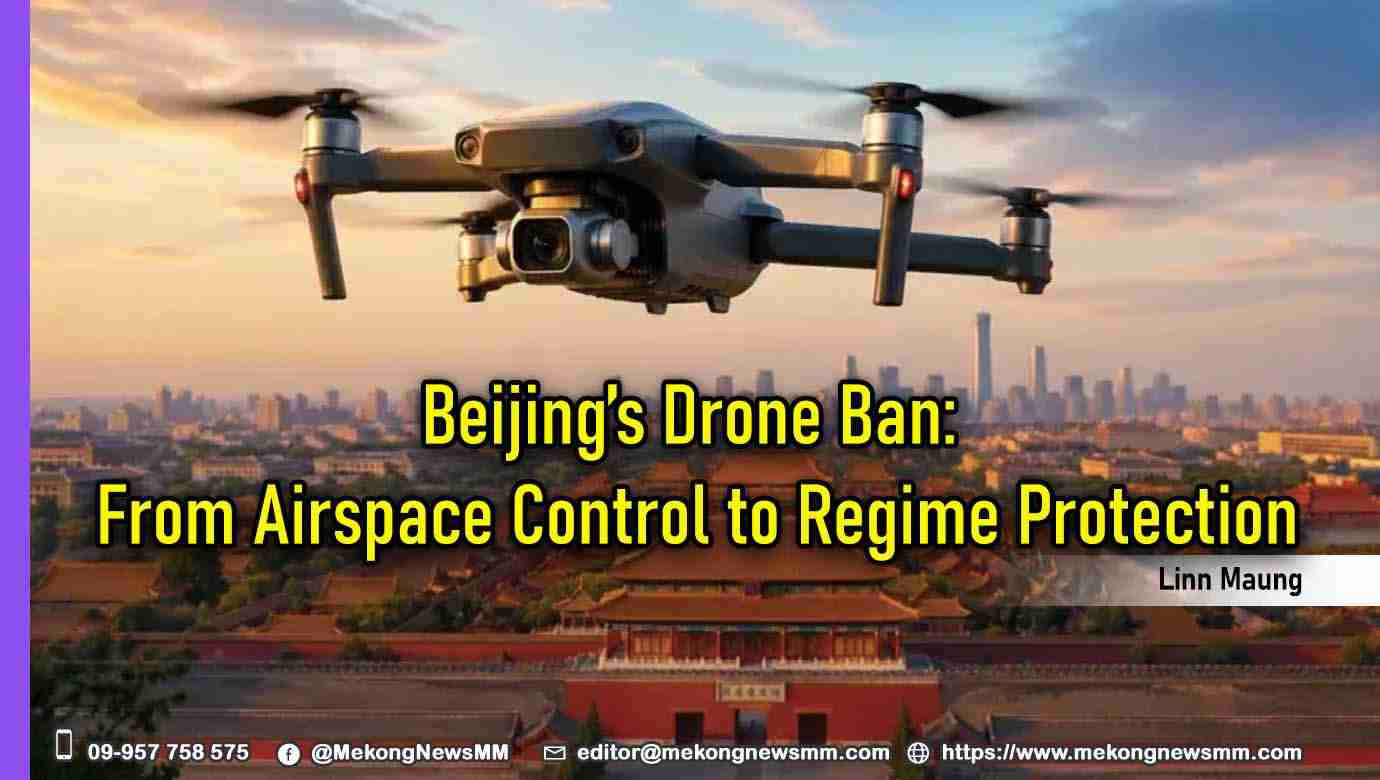
Beijing’s sweeping prohibition on the sale, transport and use of civilian drones marks more than a tightening of aviation rules—it reflects a shift in how the Chinese state is thinking about internal security. By designating the entire capital as controlled airspace and eliminating even routine civilian use, authorities have moved from regulation to preemptive measures to address the obvious danger of attacks on the ruling class.
On paper, the new framework closes loopholes that had allowed hobbyists and small operators to function in a grey zone. In practice, it signals that the leadership no longer views drones as a manageable nuisance but as a latent security threat. The ban extends beyond flight permissions: drones cannot be sold, brought into, or serviced in the city. That level of restriction suggests a zero-tolerance posture rather than calibrated risk management.
The timing is not incidental. Conflicts such as the Russia–Ukraine war and ongoing instability in parts of the Middle East have demonstrated how inexpensive, commercially available drones can be repurposed for reconnaissance, targeted strikes and disruption. These are not high-end military platforms but adaptable tools that blur the line between civilian and combat use. For a capital like Beijing, dense with political leadership compounds, military headquarters and foreign missions, the perceived vulnerability is acute.
The crackdown also reveals a deeper anxiety within the Chinese Communist Party. Security in Beijing has always been layered and intrusive, but drones introduce a vertical dimension that traditional controls, checkpoints, surveillance grids, and perimeter security struggle to contain. A single modified device breaching restricted airspace could trigger not just physical damage but political shock.
There is an economic and symbolic cost. DJI, the country’s flagship drone maker, has effectively been pushed out of its home market in the capital. The move underscores the “dual pressure” facing Chinese tech firms: tightening domestic controls alongside growing scrutiny abroad, particularly in the United States. That the world’s leading consumer drone brand cannot sell in Beijing sends a message that security imperatives now override commercial considerations—even for national champions.
At another level, the policy risks reinforcing global suspicions about Chinese drone technology. If Beijing itself treats widespread civilian drone use as a systemic risk, it lends weight to concerns in foreign markets about surveillance, data security and dual-use applications. Competitors, including manufacturers in Taiwan and elsewhere, are likely to benefit from that shift in perception.
What emerges is a pattern consistent with China’s broader governance model: when faced with uncertainty, the state opts for maximal control. The drone ban is not just about preventing an incident; it is about eliminating the conditions that might lead to one. In that sense, Beijing is not reacting to a specific threat but to a category of risk, one shaped as much by lessons from modern warfare as by the leadership’s enduring priority of regime security.
#MeKongNews