

~ Linn Maung ~
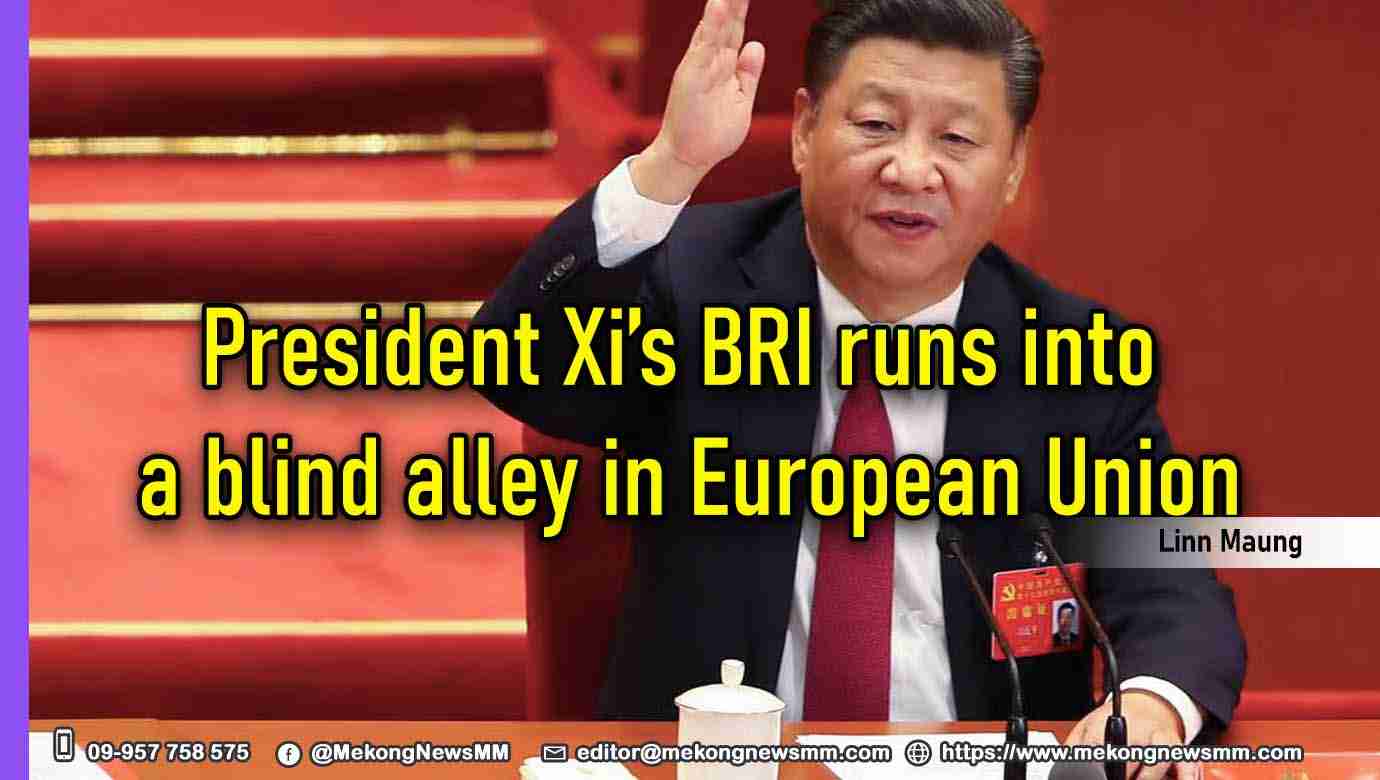
Since the coming into power of President Xi Jinping in Beijing in 2013 with his hardcore communist dogma, European Union countries have become sceptical of economic interactions with China. In the process, the Belt and Road Initiative, a brainchild of President Xi, has been rejected by the more affluent of the European nations.
The German experience is a clear pointer to this. China had come to be particularly crucial for the car industry in Germany, a pivot of the German economy. The automobile industry in Germany had become increasingly dependent on China as a source of supplies, a manufacturing base, and an export destination. For successive German governments issues like democracy and human rights were outweighed by the commercial profits German car manufacturers could generate in China. A strong focus on expanding Germany’s commercial relationship with China was the priority.
Interestingly, the first encouragement to the Germans to extend their automobile sales in China did not come from the market but from the Chinese Communist Party. Not averse to luxury, in the late 1980s a few high-level Chinese leaders made a few premium models of Mercedes-Benz their official cars in place of the domestically made Hongqi. Realizing the aura of wealth and prestige attached with Mercedes-Benz, the affluent citizens of China, too, began to be crazy for the brand.
Attracted by the success of Mercedes-Benz, rivals Volkswagen entered a joint venture with China FAW Group and the first Audi rolled off the production line in 1996. BMW formed a joint venture with Chinese Brilliance Auto in 2003 to begin producing limousines in Shenyang. In 2005 Mercedes-Benz established a joint venture with Beijing Automotive Industry Holding and started producing premium brands of the car.
The various measures introduced by President Xi curtailed the profits German companies could earn in China. Offering Chinese companies with government subsidies, low-cost raw materials, land and financial instruments, his government denied foreign companies a level playing field. An opaque data security law and an amended anti-espionage law made it difficult for foreign companies to comply with the legal requirements for cross-border data flow. The Made in China 2025 policy that encouraged discriminatory treatment of foreign investment, forced technology transfers, intellectual property theft and cyber espionage directly threatened the global commercial interests of key firms. Ultimately this change in the market environment in China led the Angela Merkel administration in Berlin to rethink its China policy.
Coming from the policy initiative stable of the same President Xi, Germany treated with scepticism the BRI which Beijing tried to push in Europe when countries in Asia and Africa started defaulting on the repayment of BRI loans. Berlin tightened the rules of foreign investments in 2018 and, in collaboration with France, Germany began pushing for stricter EU-wide regulations on foreign takeovers as well as stricter competition regulations that would target Chinese state-owned enterprises and state-subsidized firms. In 2019, BDI, the Federation of German Industries, warned against market overdependence on China.
Since 2015, China has been trying to target European countries with its BRI investments; both EU-member states and non-EU states. In 2021, the bilateral volume of trade between Europe and China was Euro 696 billion. Till 2021, China had invested in 1,000 projects in European countries under the BRI, amounting to a total investment volume of over US $226 billion. But, among the European nations, Chinese financing clearly targeted non-EU countries; most notably Russia where the total BRI investment till this period was about US $170 billion. About US $28 billion was invested in Turkey.
Unlike Germany, Italy’s initial response to the BRI was positive. In 2014, China and Italy signed an MoU on jointly advancing the Silk Road Economic Belt and the 21st Century Maritime Silk Road. In 2019, Italy was the first G 7 nation to sign an MoU with China on participation in the BRI.
For China, investment in Italy was an attractive proposition as this provided Chinese state-owned enterprises a foothold in the Mediterranean Sea, where China has sought to expand its strategic presence through various investments. Through COSCO Shipping, China had already gained control of the port of Piraeus in Greece and the flooding of the European consumer market with Chinese goods had started.
The disenchantment of Italy with the BRI also set in for reasons similar to Germany’s; when the perceived economic benefits from BRI failed to materialize. In 2021, Rome froze the agreement signed with China in 2019 and launched a critical screening of Chinese investments in Italy. At least three Chinese acquisitions of Italian firms were blocked. Prime Minister of Italy Mario Draghi limited Chinese strategic investments in infrastructure, blocked access to key strategic technologies, and shielded distressed Italian companies against takeovers by Chinese firms. In particular, the acquisition of semiconductor manufacturing firms was prevented.
In 2022, Italy formally exited from the BRI; with Prime Minister Giorgia Meloni describing the decision to join the BRI as a “big mistake.” Meloni did not solely refer to economic imbalances as reasons for her reservations against the BRI. She made it clear that she was opposed to the oppression of the Uighur people in Xinjiang and China’s hostility towards Taiwan.
Notably, Germany continues to have substantial commercial exchanges with China. The total German exports to China in 2024 was valued at $95 billion, the value of the total German imports from China in that year was $170 billion. Thus, while countries in Europe continue to have trade relations with China, BRI has failed to make a headway in the EU countries. This is because BRI is a different kettle of fish. It is a state-led, strategic initiative aimed at financing large-scale infrastructure to promote geo-political aims of the Chinese Communist Party. BRI projects are typically financed by Chinese state-owned enterprises and policy banks which serve the goals of the CCP.
Not surprisingly, the Socialist Democratic Party, the Greens and the Free Democratic Party which together ruled Germany between 2021 and 2024 were of the view that Beijing was aiming to establish regional hegemony, reshape the existing rules-based international order and create economic and technological dependencies which could be used to promote the political objectives of the CCP. “China has changed, and that’s why our policy towards China also needs to change,” then Foreign Minister of Germany Annalena Baerbock had said, recommending a cautious policy towards China.
With experience like that of Montenegro which borrowed $1 billion from China in 2014 as part of BRI for the construction of a highway, European nations are growing increasingly sceptical of the BRI. The debt incurred accounted for more than a third of Montenegro’s annual budget and threatened to leave the country bankrupt before a group of European and US banks assisted the government in restructuring the loan and enhancing debt sustainability. The Chinese firm engaged to build the highway ultimately did not even complete the construction.
Faced with the growing concern in the EU over the BRI investments, Beijing has been shifting toward smaller and more sustainable investments in an attempt to project the BRI as an “open, green, and clean initiative.” In Western Europe, the BRI is moving away from physical infrastructure projects and investment in industrial assets, which are being protected from Chinese takeovers by both national and EU legislation, to financial and monetary connectivity, hi-tech manufacturing and clean energy. Strategic partnerships are being set up in electrical vehicles and battery production. It is difficult, however, to distinguish such BRI investments from routine Chinese investments.
#MeKongNews