

~ Linn Maung ~
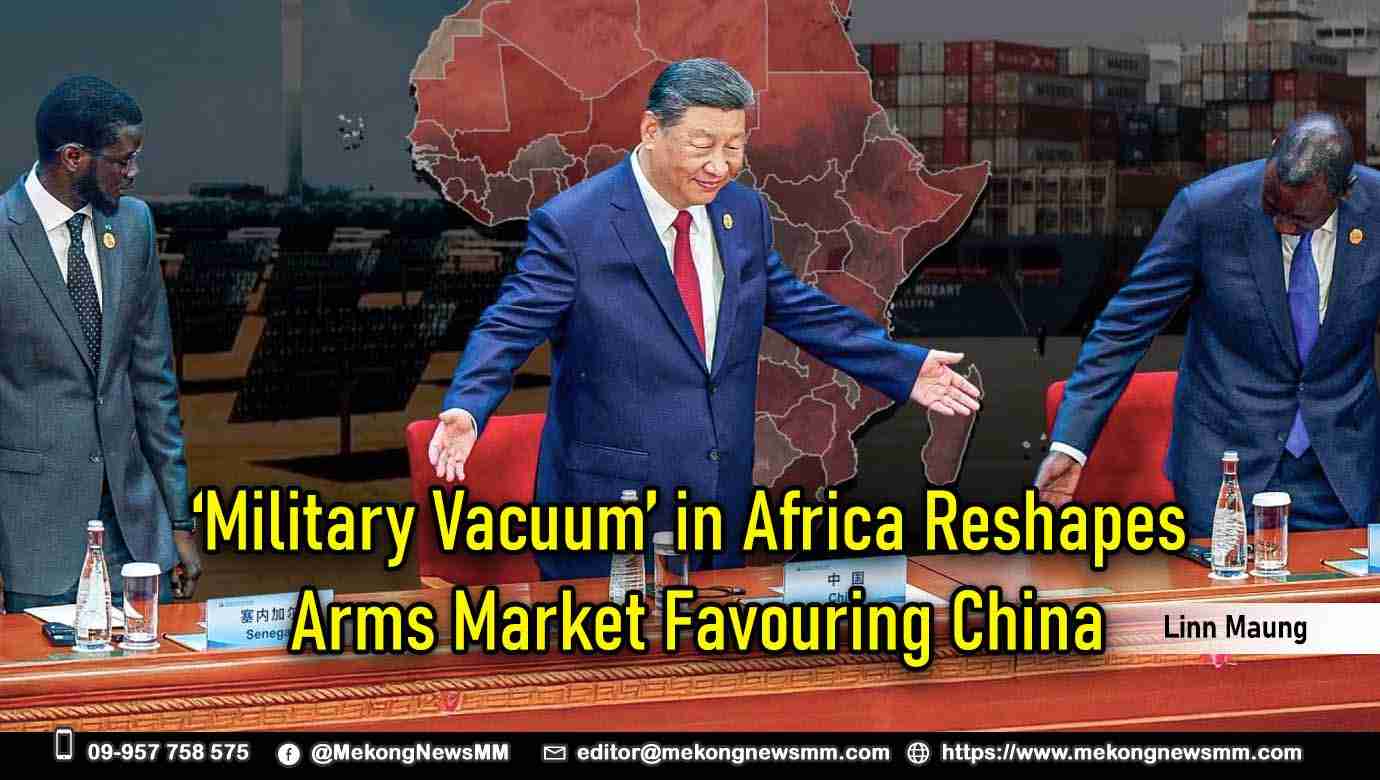
The withdrawal of French forces from the Sahel and Russia’s reduced export capacity due to the Ukraine war have combined to create what analysts describe as a “military vacuum” across West and Central Africa. That space is not empty for long. China has moved swiftly to consolidate its position.
The shift began after the wave of coups in Burkina Faso, Mali and Niger from 2020 onward. These upheavals dismantled long-standing security partnerships, particularly with Paris. France’s counterterrorism mission, once central to regional security architecture, has wound down. In parallel, Russia, preoccupied with sustaining its war effort in Ukraine, has struggled to maintain previous levels of arms deliveries and support to overseas clients.
Chinese defence industry assessments have openly acknowledged this transition. A January report in China Military to Civilian, published under the aegis of the State Administration of Science, Technology and Industry for National Defence, described the French exit as creating “space” for China’s military trade expansion. The report, attributed to the state arms exporter China National Aero-Technology Import & Export Corporation, argued that Beijing is leveraging cost-effective systems and flexible financing to penetrate African markets.
Market Substitution in Motion
The term used in the Chinese analysis, “market substitution”, is significant. As reliance on French and Russian platforms declines, procurement patterns are shifting toward Chinese equipment, particularly in segments such as drones, armoured vehicles and small arms.
Data from the Stockholm International Peace Research Institute (SIPRI) indicates that from 2020 to 2024, China accounted for 26 per cent of West African arms imports. France followed at 14 per cent, with Russia and Turkey at 11 per cent each. SIPRI also noted that Chinese exports to West Africa during this period reached their highest recorded level.
Importantly, China’s expansion is not confined to states that have distanced themselves from Paris. Senegal and Ghana, both historically aligned with France and Western security partners, have also increased purchases of Chinese systems. In Burkina Faso and Mali, post-coup governments have accelerated procurement amid intensifying insurgencies.
The Sahel as Strategic Test Case
The recalibration is most visible in the Sahel. Military juntas facing persistent insurgencies require equipment that is affordable, rapidly deployable and relatively easy to maintain. Chinese suppliers have targeted this niche.
China’s largest arms manufacturer, Norinco, has established offices in Nigeria and Senegal, underscoring a longer-term commercial strategy. In 2024, Mali’s transitional President, Assimi Goïta, visited Beijing and signed a comprehensive defence agreement with Norinco, reinforcing Bamako’s pivot toward Chinese hardware. Burkina Faso has followed a similar trajectory, acquiring armoured personnel carriers and tactical drones for counter-insurgency operations. Niger, too, has deepened procurement ties with Beijing.
China’s advantage lies less in high-end combat aircraft or advanced missile systems, markets still dominated by the United States and Russia, and more in scalable platforms suited to internal security operations. Competitive pricing and permissive financing arrangements appeal to fiscally strained governments confronting insurgencies and sanctions-related constraints.
Beyond Hardware: Institutional Entrenchment
Arms transfers are only one element of Beijing’s expanding footprint. The 2024–2027 Beijing Action Plan under the Forum on China-Africa Cooperation (FOCAC) includes commitments to train 6,500 military personnel, signalling deeper institutional engagement.
This lower-profile strategy avoids large-scale troop deployments. Instead, China is strengthening defence attaché networks, conducting naval port calls and expanding training exchanges. Chinese private security firms are also protecting infrastructure linked to Beijing’s economic projects.
This model contrasts with Russia’s more direct security involvement in parts of Africa and avoids the political sensitivities that accompanied France’s counterterrorism presence.
Competitive Landscape
China is not operating uncontested. Turkey has emerged as a significant competitor in drones and armoured vehicles. The United States retains influence in higher-end systems and training partnerships. Russia’s security networks, though strained, remain embedded in certain theatres.
Analysts caution that while China’s market share is expanding steadily, dominance is far from assured. The Sahel’s instability generates demand but also creates volatility and political risk.
A Security Actor in Transition
What distinguishes the current phase is not simply increased arms sales, but a broader repositioning. Beijing is framing itself as a comprehensive security partner, one that combines trade, training and financing without overt political conditionality.
The erosion of France’s operational presence has unsettled established security arrangements. In that unsettled space, China is building influence incrementally rather than dramatically, through contracts, training programmes and industrial presence.
The “military vacuum” narrative may overstate the absence of other powers. But the data shows a clear trend: as Western footprints shrink and Russian supply lines tighten, China’s role in West and Central Africa’s defence landscape is expanding, methodically, commercially and with long-term strategic intent.
#MeKongNews