

~ Linn Maung ~
This year commemorates the 75th anniversary of diplomatic ties between China and Myanmar. In a time characterized by fractured alliances and evolving geopolitical dynamics, the Chinese Communist Party (CCP) and Myanmar’s military junta have marked what they refer to as the enduring ‘Pauk-Phaw’ friendship, a phrase that embodies a sibling-like bond of mutual trust and support. However, beneath this carefully constructed narrative lies a profoundly unequal partnership, where Beijing’s backing functions more as a strategic maneuver than as genuine solidarity.
Following the military coup in February 2021, Myanmar’s junta leader, Senior General Min Aung Hlaing, encountered widespread international condemnation, sanctions, and domestic armed resistance. In this legitimacy vacuum, China intervenednot to advocate for democratic principles, but to safeguard its long-term interests. From arms transactions to diplomatic protection at the UN Security Council, Beijing has emerged as the regime’s most steadfast international ally.
The CCP’s steadfast backing has allowed the junta to withstand global isolation. Yet, this support comes with significant repercussions. Myanmar is increasingly reliant on China for diplomatic acknowledgment, investment, and security assistance, solidifying a relationship where the junta is relegated to a subordinate role-politically submissive and economically dependent.
China has adeptly turned Myanmar’s economic vulnerabilities into a strategic advantage. As Western sanctions stifle investment, Chinese enterprisesoften state-supportedfill the gap, securing preferential access to critical sectors such as mining, energy, and infrastructure. Many of these agreements are made without transparency or oversight, highlighting the junta’s urgent need for foreign investment and Beijing’s desire for unregulated resource extraction.
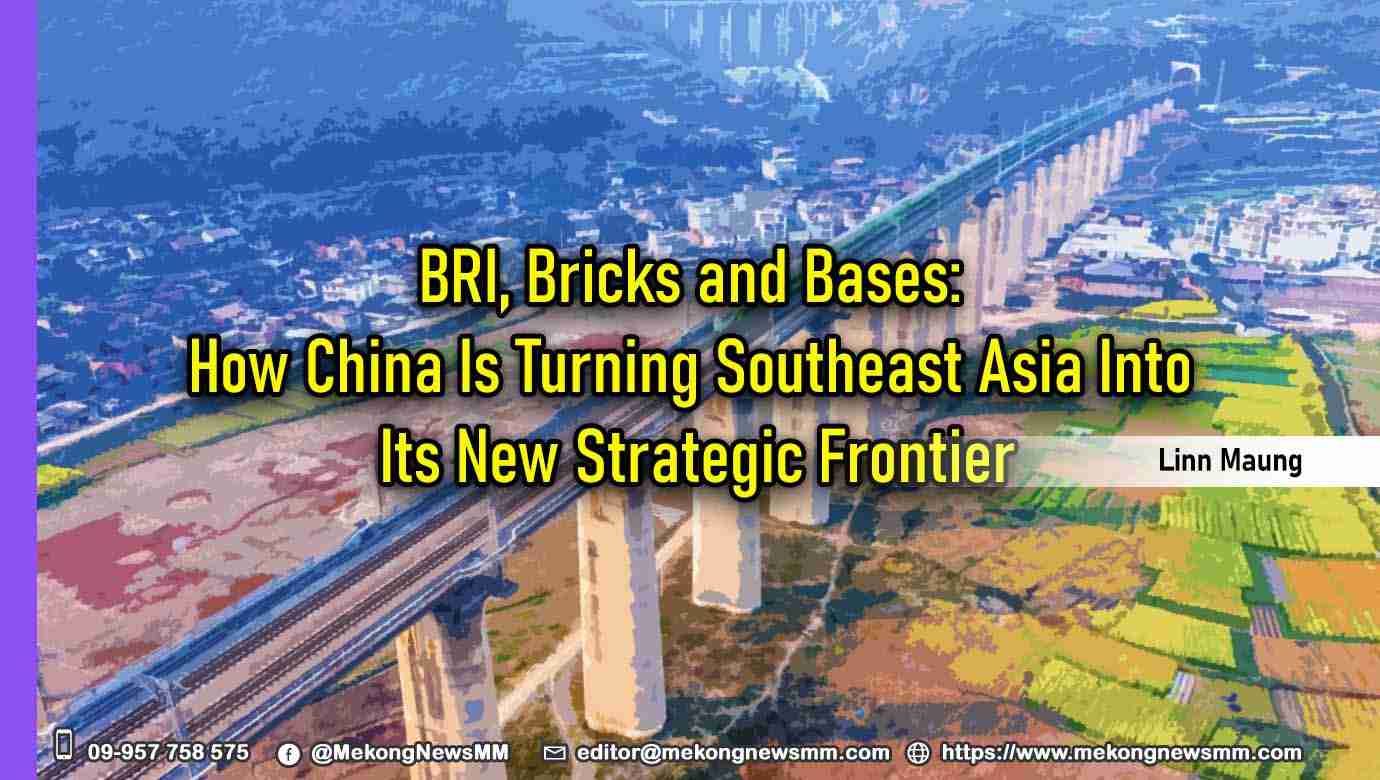
Chinese infrastructure initiatives, such as the China-Myanmar Economic Corridor (CMEC), play a pivotal role in Beijing’s Belt and Road Initiative, significantly expanding China’s economic influence. While these projects are ostensibly designed for development, they often disproportionately favor China. Take, for instance, the Kyaukphyu deep-sea port and special economic zone, which serves as a strategic trade conduit for Beijing to the Indian Ocean, yet offers scant advantages to Myanmar’s struggling local economy, which continues to grapple with underdevelopment and instability.
There have been alarming reports of Chinese firms taking advantage of local labor, displacing native communities, and inflicting environmental harm. With the military regime focused on maintaining its grip on power, there is little oversight or opposition. For China, this absence of regulation is not a drawback; rather, it serves as a green light to extract resources, construct projects, and assert dominance.
A particularly underreported facet of China’s economic expansion into Myanmar is the extraction of rare earth elements (REEs), crucial for high-tech sectors, electric vehicles, and military equipment. As environmental regulations tighten around China’s domestic reserves, its companies have increasingly turned to Myanmar, especially in the Kachin and Shan states, to fulfill their needs.
For example, the Padaung, a lesser-known subgroup of the Kayan ethnic group, boasts around 3,000 members and a lineage spanning 381 years in Shan State, located in eastern Myanmar. They report that the Myanmar-based Four Star Company, in collaboration with a Chinese partner, has proposed a large-scale mining project upstream from their village, Thi Kyeik, in Pekhon Township. Although heavy machinery began arriving in February this year, the tribe claims they were not consulted about the project and are concerned it will contaminate their land with toxic chemicals.
A 2023 investigation by Global Witness revealed that more than 300 illegal rare earth mining sites in northern Myanmar, mostly controlled by Chinese firms or their proxies, have led to devastating ecological consequences. These mines operate with little to no regulation and often in partnership with local militias or warlords aligned with the junta, creating a triple threat: environmental degradation, civil conflict, and cross-border corruption.
Despite China’s official policy of ‘green development,’ its actions in Myanmar tell another story. The environmental destruction in these areas-from acid leaching to toxic runoff-is staggering. Chinese buyers dominate the entire supply chain, from mining to transport, with most REEs exported back to China, reinforcing Beijing’s monopoly over global supply. For Myanmar, there are few benefits-only ruined landscapes and communities left to bear the long-term costs of China’s green future.
In the West, Myanmar’s civil war is often described as a ‘forgotten conflict.’ But for China, the country is a key battleground where Beijing’s regional ambitions, economic interests, and security concerns intersect. A weakened Myanmar is central to China’s goal of establishing uncontested regional hegemony. If Beijing can dominate the country, it constitutes both a strategic barrier against India’s ‘Act East Policy,’ which aims to link India with the fast-growing Southeast Asia region, and a vital foothold for China in mainland Southeast Asia and on the shores of the Indian Ocean.
Other way Myanmar’s geography offers China a strategic treasure: a direct route to the Indian Ocean. This is central to Beijing’s efforts to reduce its reliance on the Strait of Malacca-a chokepoint vulnerable to U.S. or Indian naval intervention. Through the Kyaukphyu port in Rakhine State, China has constructed oil and gas pipelines running to Kunming in Yunnan province, allowing energy imports from the Middle East and Africa to bypass the South China Sea entirely.
Since their inception in 2013, the China-Myanmar Oil and Gas Pipelines have transported more than 200 million barrels of crude oil and vast quantities of natural gas. Yet, the benefits for Myanmar’s populace have been minimal. Local residents report instances of land seizures, forced relocations, and inadequate compensation, while the military junta profits through unclear profit-sharing deals.
The energy infrastructure projects initiated by China are heavily guarded by military forces from both China and Myanmar, highlighting their strategic significance. This military presence provides Beijing with considerable leverage over the junta, which must ensure these operations run smoothly to avoid jeopardizing their most crucial ally.
China’s expanding influence in Myanmar transcends mere resource acquisition; it is a calculated geopolitical strategy aimed at securing its southwestern borders and countering Western dominance in the Bay of Bengal. Myanmar acts as a critical pivot in Beijing’s larger Indo-Pacific strategy, serving as both a buffer against India and a base for asserting its authority in Southeast Asia.
Firstly, Beijing has utilized its sway over the junta to weaken India’s foothold in its northeastern territories. Intelligence assessments suggest that China is providing support to insurgent factions in India’s northeast, many of whom find sanctuary and weaponry in Myanmar’s lawless regions. This strategy allows China to exert pressure on India without engaging in direct conflict.
Secondly, Beijing exploits Myanmar to fracture ASEAN’s cohesion and hinder Western efforts in the area. By supporting the junta, China effectively quashes demands for democratic reforms, complicates UN interventions, and obstructs Western attempts to diplomatically isolate Myanmar. Chinese vetoes in the Security Council have protected the junta from international condemnation, granting it a shield of diplomatic immunity.
Thirdly, the Bay of Bengal is evolving into a quiet battleground for naval competition. The Kyaukphyu port offers China a strategic foothold near India’s eastern coastline, potentially serving dual purposes. Recent satellite images and local accounts suggest a growing Chinese presence and enhancements to port facilities that align with naval requirements.
Despite its claims of ‘non-interference,’ China is intricately woven into Myanmar’s security framework. The guise of the ‘Pauk-Phaw’ relationship conceals a transactional dynamic, where Beijing’s strategic goals overshadow every interaction-from infrastructure projects to intelligence sharing.
As the junta desperately holds onto power and democratic nations grapple with formulating a unified response, China is methodically embedding itself in all aspects of Myanmar’s governance. From the mining regions in the Kachin hills to the pivotal ports of Rakhine, Myanmar is transforming into a geopolitical pawn in Beijing’s grand strategy, exploited for its resources, energy routes, and regional influence.
The so-called ‘Pauk-Phaw’ friendship has devolved into a relationship devoid of equality, if it ever possessed such a quality. It is a carefully crafted illusion that conceals a glaring disparity. China’s economic and strategic exploitation is cloaked in the rhetoric of camaraderie, yet it is propelled by self-serving motives and opportunism. For the junta, China serves as both a lifeline and a tether-sustaining its existence while ensuring its subservience.
The future of Myanmar hinges not only on internal resistance to authoritarian rule but also on the reactions of regional and global players to China’s advances. Absent a concerted international effort, Myanmar risks further entrenchment in China’s sphere of influence-sacrificing its sovereignty, environmental integrity, and autonomy in the process.
Ultimately, the 75th anniversary of Myanmar-China relations is not a commemoration of mutual respect but a stark reminder of how unchecked power can alter destinies.
#MeKongNews