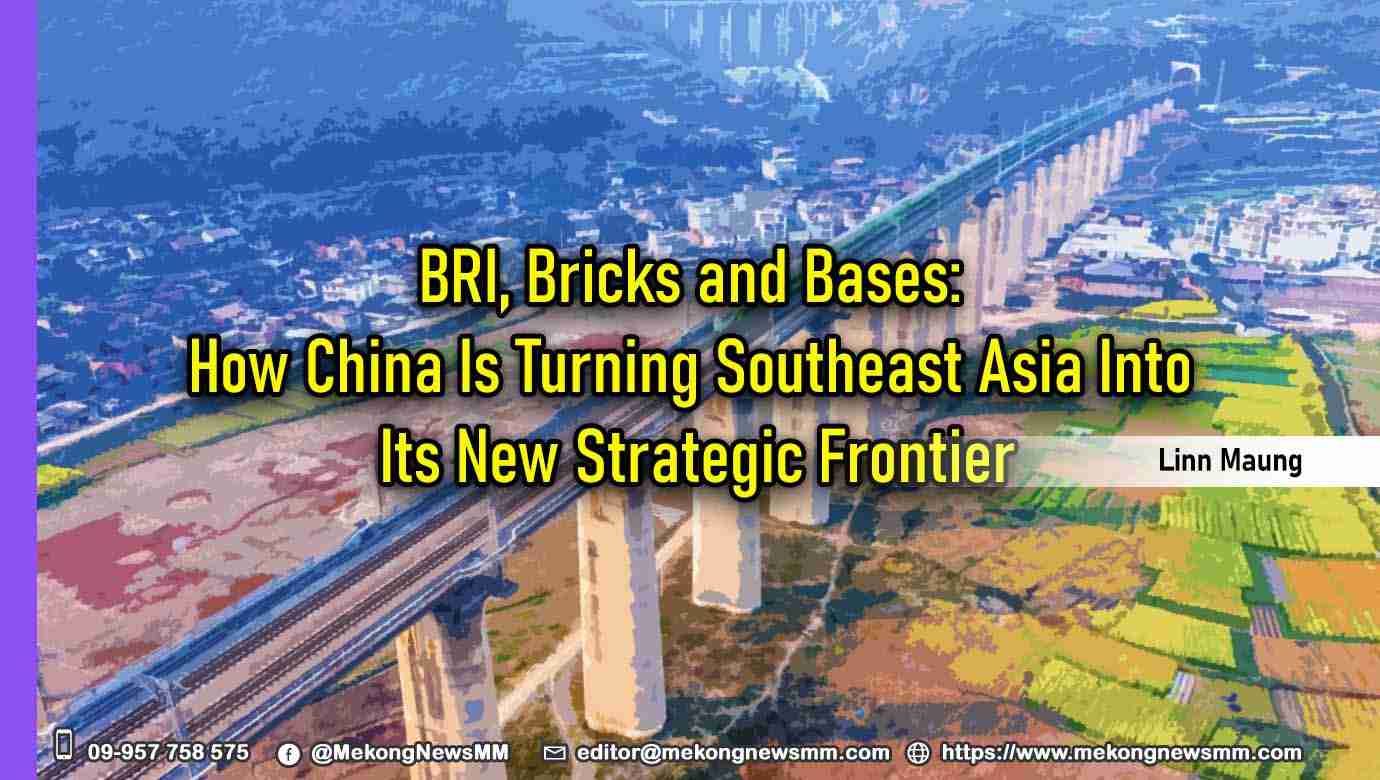


~ Linn Maung ~
Beijing’s renewed focus on utilising its geographical advantages as an upper riparian state has caused severe concerns among countries on the receiving end of such actions. The scale, pace, and unilateral nature of Beijing’s hydro-infrastructure expansion, particularly across the Tibetan Plateau and the upper reaches of major rivers like the Brahmaputra and Mekong, pose serious threats to ecological balance, regional stability and institutional trust in Asia’s hydro politics.
China controls the headwaters of several major Asian rivers, including the Brahmaputra and Mekong among others. Despite this upstream advantage, it has resisted all efforts toward legally binding multilateral frameworks for water governance. Living up to its past precedent, Beijing has preferred to be non-transparent, non-binding to bilateral mechanisms and has frequently used hydrological data sharing as a political lever.
During the 2017 Doklam standoff with India, China suspended hydrological data sharing for the Brahmaputra, citing technical difficulties. However, the suspension coincided precisely with a period of elevated tensions, signalling how Beijing was willing to politicize routine data sharing during times of crisis. The absence of institutionalized mechanisms of coordination has also enabled strategic unpredictability for downstream states and has left them vulnerable to sudden changes in upstream behaviour.
Furthermore, China’s dam construction has also been opaque in terms of its feasibility studies. Environmental impact assessments (EIAs) have been conducted unilaterally without input from downstream stakeholders. There is no publicly available cumulative impact assessment of its existing and proposed dams on shared rivers, nor are there mechanisms for dispute resolution. This has further undermined cooperative hydro-diplomacy in Asia and continues to create an asymmetry of power that favours Beijing.
Unilateral Actions with Multilateral Implications
Beyond the geopolitical implications the environmental consequences of China’s dam-building too are unfavourable for the larger Asian region. The upper reaches of the Brahmaputra, Mekong, and Salween flow through ecologically fragile zones. Dams in these regions disrupt the natural flow regime, sediment transport, and seasonal flood pulses that are essential for downstream agriculture, fisheries, and delta maintenance.
In the Mekong Basin, a 2020 study conducted found that China’s upstream dams had withheld significant volumes of water during the 2019 monsoon season, contributing to record-low water levels in Thailand, Laos, Cambodia, and Vietnam, even as precipitation upstream was above average. The Mekong River Commission (MRC), a regional intergovernmental body, has repeatedly raised concerns about how upstream dam operations are altering hydrological cycles and threatening food security for over 60 million people.
On the Brahmaputra, while comprehensive data is lacking due to China’s opacity, Indian experts and policymakers have raised serious concerns about the Zangmu and the planned “super dam” close to the Arunachal Pradesh border. Given the Brahmaputra’s high sediment load and seismic vulnerability, damming introduces additional risks of downstream flooding, reducing sediment flow and posing infrastructural stress. In the absence of a basin-wide environmental governance mechanism, these damages are borne unilaterally by downstream states without compensation, consultation, or mitigation.
Strategic Risks and Water as a Tool of Influence
In light of such tactics, Beijing’s dam-building must be understood in the context of its broader strategic behaviour. Dams and rivers have acted as instruments of influence in times of crisis for China. Unlike kinetic forms of coercion, water control offers a deniable, indirect lever that can destabilize adversaries without escalating to overt conflict. A 2021 report by a leading think-tank warned that in the absence of transparency and prior-notification regimes, upstream control can enable ‘hydraulic power projection’. During times of political or military friction, upstream states can induce artificial water stress through sudden dam releases or withholding flows, without attribution or accountability. This possibility is particularly acute in the Sino-Indian context, given the history of border tensions and the potential for non-traditional security threats to escalate during crises.
Moreover, China’s water diplomacy has often lacked reciprocity. While it expects hydrological cooperation from downstream states in multilateral forums like the Lancang-Mekong Cooperation Mechanism, it resists similar commitments for rivers where it holds upstream dominance. This asymmetric approach undermines trust and reduces the incentives for cooperative behaviour, especially from equally powerful downstream actors like India.
A critical enabling condition for China’s actions is the institutional vacuum in Asia’s transboundary water governance. Unlike Europe or parts of Africa, where basin-wide legal institutions like the Danube River Commission or Nile Basin Initiative exist, Asia lacks a coherent legal framework to manage shared rivers. China has continued to exploit this gap to pursue its domestic objectives without external oversight. Attempts to promote regional frameworks, such as the MRC in Southeast Asia have been repeatedly thwarted by China’s preference for bilateralism and strategic ambiguity. This refusal to institutionalize interdependence represents a challenge not only to immediate neighbours but also to the broader principle of rules-based regional order in Asia.
Therefore, China’s hydro-behaviour must be factored into broader national security and regional strategy calculations. Beijing’s dam construction is not simply a function of domestic energy demand or developmental planning; it is a geopolitical act with regional consequences. By operating outside of international legal norms, ignoring ecological risks, and weaponizing water as a tool of influence, Beijing has undermined both environmental sustainability and regional stability. The international community, particularly Asia’s downstream nations, must therefore recognize dam diplomacy for what it is: a subtle but significant form of coercive statecraft. The response therefore must be strategic, institutional, and grounded in the principle that China’s attempts to dominate downstream regions will not be tolerated.
#MeKongNews