

~ Linn Maung ~
Few cities have witnessed such a dramatic political transformation as Hong Kong. Once known for its independent courts, free media, civil liberties, and energetic democratic culture, the territory stood as a beacon of freedom in the Chinese-speaking world. Today, however, Beijing’s tightening control is steadily erasing the very characteristics that made Hong Kong unique, replacing political pluralism with an atmosphere of fear, conformity, and uncertainty.
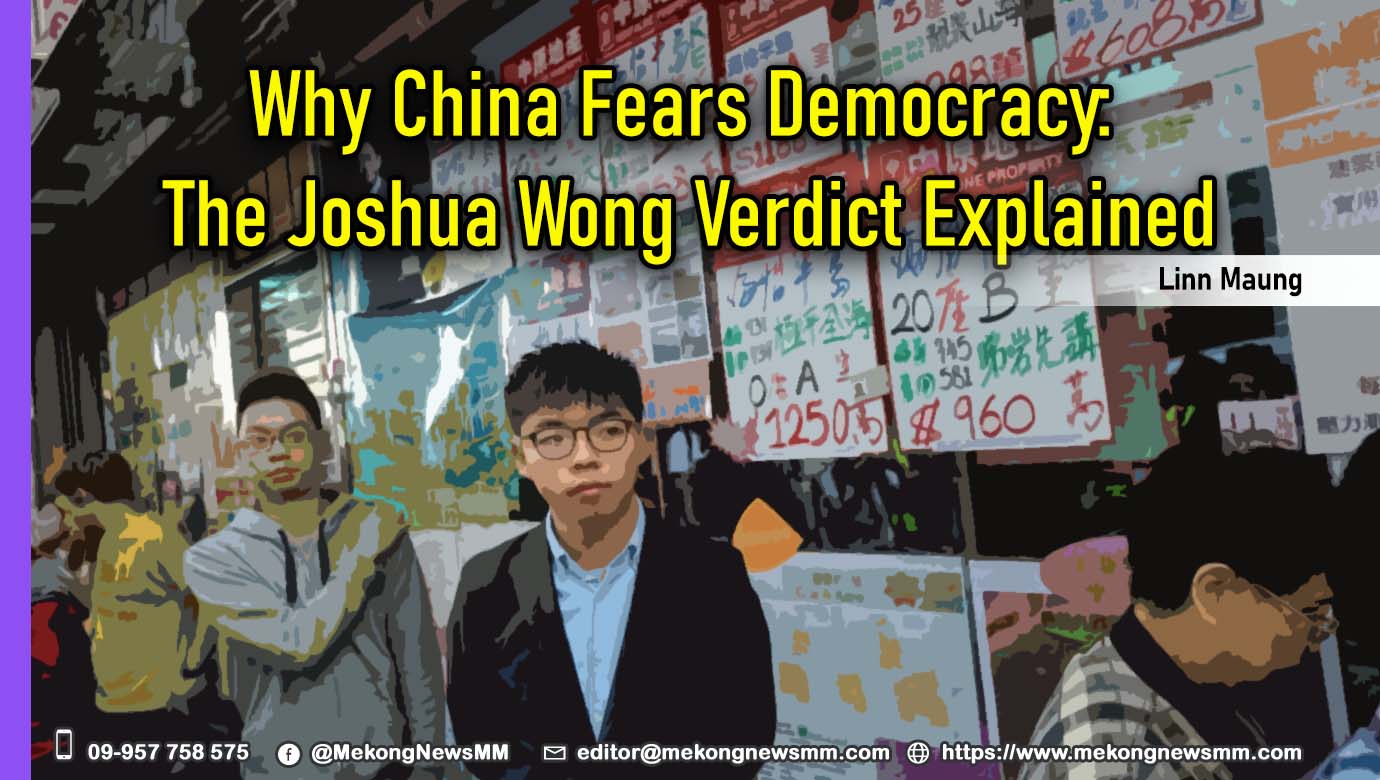
The latest evidence arrived with the sentencing of pro-democracy activist Joshua Wong to an additional ten years in prison under Hong Kong’s National Security Law. Once celebrated globally as the youthful face of the Umbrella Movement and later the 2019 pro-democracy protests, Wong has become a symbol of a far larger struggle: the battle between authoritarian control and democratic aspirations.
His punishment is not merely about one activist. It is a message. A warning. A declaration by Beijing that organised democratic opposition in Hong Kong will not be tolerated.
Since the National Security Law was imposed by Beijing in 2020, Hong Kong’s political landscape has been transformed beyond recognition. The law was introduced after the massive anti-government protests that shook the city in 2019. Chinese authorities argued that the legislation was necessary to restore stability and safeguard national security. Critics, however, contend that it has become a tool to criminalise dissent, silence opposition politicians, restrict civil liberties, and deter future democratic activism.
The figures tell a troubling story. Dozens of opposition politicians, activists, lawyers, journalists, and civil society leaders have been arrested, prosecuted, or forced into exile. Independent media outlets that once challenged authority have shut down. Opposition parties have effectively ceased to function. Elections have been restructured to ensure that only candidates deemed “patriots” can govern the city. The democratic space that existed in Hong Kong just a few years ago has shrunk dramatically.
Hong Kong’s latest blow to the pro-democracy movement came when activist Joshua Wong, one of the most recognisable faces of the city’s democratic struggle, was sentenced to an additional 10 years in prison under the Beijing-imposed National Security Law. Wong, already imprisoned since 2020 and previously convicted in the landmark “Hong Kong 47” national security case, pleaded guilty to charges related to alleged collusion with foreign forces. Rights groups, Western governments, and democracy advocates argue that the case is part of a broader effort by Beijing to extinguish political dissent and dismantle the democratic aspirations that once defined Hong Kong under the “One Country, Two Systems” framework.
Joshua Wong’s new sentence is particularly significant because the charges stem largely from international advocacy efforts. According to court proceedings, authorities viewed calls for foreign governments to place pressure on Chinese and Hong Kong officials as a threat to national security. To many democracy advocates, however, such lobbying represents a common and legitimate feature of global political activism.
The central question therefore becomes: Why is Beijing so determined to crush democratic activism?The answer lies in the Chinese Communist Party’s political philosophy.
The CCP’s legitimacy is based not on electoral competition but on political control, economic performance, and national unity. Competitive democracy introduces uncertainty. It creates alternative centres of power. It allows public criticism to evolve into organised political opposition. For a party that has governed China uninterrupted since 1949, such developments are viewed not as healthy political competition but as potential threats to regime stability.
Hong Kong represented a unique challenge because it demonstrated that Chinese citizens could enjoy freedoms unavailable on the mainland while still remaining part of China. For Beijing, the city’s democratic movement risked becoming an example that could inspire similar demands elsewhere.
That concern became even more pronounced after the 2019 protests, when millions of Hong Kong residents participated in demonstrations demanding greater accountability, democratic reforms, and protection of civil liberties. The movement attracted international attention and generated sympathy across democratic societies. Chinese leaders interpreted the unrest as evidence of foreign interference and a direct challenge to national sovereignty.
The result has been a comprehensive campaign to eliminate what Beijing sees as sources of political instability.
The territory was promised a high degree of autonomy under the “One Country, Two Systems” model following the 1997 handover from Britain to China. Many observers now argue that this arrangement has been fundamentally altered. The increasing use of national security legislation, the arrest of opposition figures, and the tightening of political controls have raised serious questions about the future credibility of Beijing’s international commitments.
International reactions have been equally sharp. Human Rights Watch described Joshua Wong’s latest sentence as “cruel and unjust.” Amnesty International argues that the National Security Law has increasingly been used to punish dissent rather than protect security. Governments in the United States, Europe, and Taiwan have repeatedly expressed concern over the shrinking political freedoms within Hong Kong.
Chinese officials continue to insist that Hong Kong’s courts operate independently, that the National Security Law is essential for stability, and that those convicted have violated legitimate laws rather than being targeted for their political beliefs. In Beijing’s view, restoring order outweighs concerns raised by foreign governments or human rights organisations.
History repeatedly shows that suppressing political participation may silence dissent temporarily, but it rarely eliminates democratic aspirations. Ideas are considerably harder to imprison than individuals. Joshua Wong’s imprisonment may remove him from public life for years, but it cannot erase the questions that millions of Hong Kong residents once raised about representation, accountability, and freedom.
Ultimately, the sentence is about more than one activist. It reflects Beijing’s determination to ensure that Hong Kong never again becomes the centre of a mass democratic movement. By making examples of prominent figures such as Joshua Wong, Jimmy Lai, and other opposition leaders, the Chinese Communist Party seeks to discourage future generations from challenging its authority.
The message from Beijing is unmistakable: political loyalty comes before political liberty.The question confronting the world is equally clear: how long can a city once celebrated as Asia’s freest society remain recognisable after the systematic dismantling of the very freedoms that made it unique?
References:
https://www.reuters.com/world/china/hong-kong-activist-joshua-wong-set-be-sentenced-national-security-charge-2026-11-04/
https://www.hrw.org/news/2026/11/05/hong-kong-joshua-wong-gets-nearly-10-more-years-in-prison
https://www.theguardian.com/world/2026/nov/05/hong-kong-joshua-wong-sentenced-national-security-case
Jailed Hong Kong activist Joshua Wong sentenced to 10 years over foreign collusion
#MeKongNews