

~ Linn Maung ~
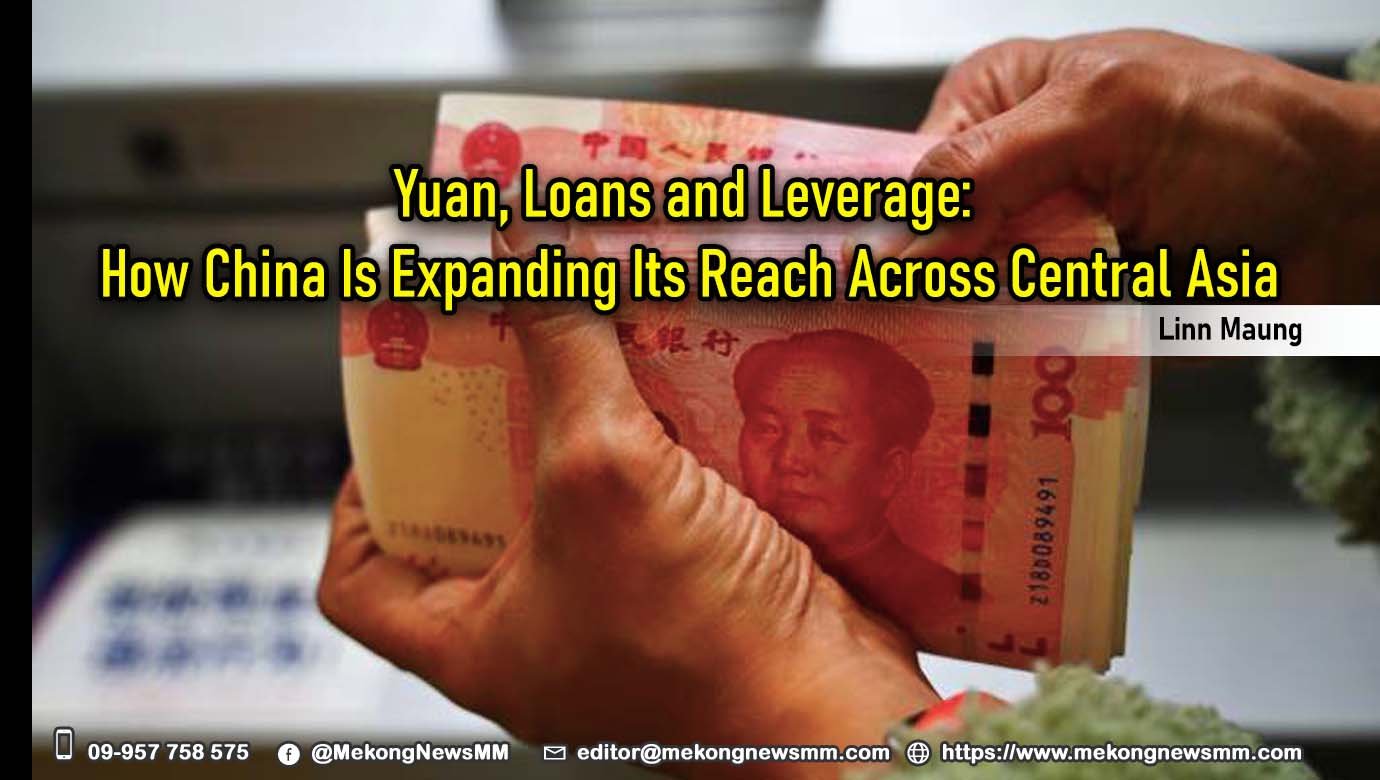
A quiet but significant shift is taking place in Central Asia, and it is being driven not by military deployments or political alliances but by money. Kazakhstan’s growing reliance on yuan-denominated financing offers a glimpse into China’s evolving strategy for expanding its influence across its western neighbourhood. Recent sovereign panda bond issuances by Kazakhstan, amounting to billions of yuan, have highlighted Beijing’s ability to provide borrowing at interest rates that are often more attractive than those available in many international markets. For Kazakhstan and other Central Asian economies seeking affordable capital to fund infrastructure, industrial expansion and trade, Chinese financing has become an increasingly appealing option, yet behind these favourable terms lies a broader strategic picture that extends far beyond simple economics.
China’s outreach to Central Asia has accelerated in recent years through a combination of trade, infrastructure investment, financial cooperation and supply-chain integration. Kazakhstan, the region’s largest economy and a crucial transit hub for Eurasian trade, occupies a particularly important place in Beijing’s calculations. The country sits at the crossroads of the Belt and Road Initiative, linking China with Europe, Russia and the Middle East. By offering low-cost financing through panda bonds, yuan settlements, state-backed lending facilities and bilateral financial arrangements, Beijing is steadily embedding itself within Kazakhstan’s economic architecture. What appears to be an effort to facilitate trade and investment can also be interpreted as an attempt to create long-term financial interdependence.
The attraction of Chinese financing is straightforward, Chinese capital markets possess abundant liquidity, and Beijing has demonstrated a willingness to support cross-border projects that align with its strategic interests. For Central Asian governments and corporations facing tighter global credit conditions, borrowing in yuan can significantly reduce financing costs. The ability to raise funds directly in Chinese currency is especially useful for entities purchasing machinery, industrial equipment, telecommunications systems and other goods from Chinese suppliers. By borrowing in yuan and paying Chinese companies directly, borrowers avoid some currency-conversion costs and gain access to competitively priced credit. This creates a self-reinforcing cycle: more trade with China increases demand for yuan financing, while greater yuan financing encourages further trade with China.
Beyond Kazakhstan, similar dynamics are visible across parts of Central Asia, countries such as Uzbekistan, Kyrgyzstan and Tajikistan have expanded economic engagement with Beijing through infrastructure projects, transport corridors, mining ventures and energy cooperation. Chinese banks and state-backed institutions have become prominent financiers of roads, railways, power plants and logistics networks. Critics argue that this growing financial footprint increases the likelihood of economic dependence, while supporters maintain that Chinese funding fills development gaps that other lenders are unwilling or unable to address, regardless of this perspective, the trend is unmistakable: China is becoming an increasingly important source of capital throughout the region.
The yuan itself occupies a central place in this strategy. For years, Beijing has sought to elevate its currency from a largely domestic medium of exchange into an international financial instrument capable of competing more effectively with the US dollar and, to a lesser extent, the euro. Every new yuan-denominated bond issuance, currency-swap agreement or trade settlement arrangement advances that objective. If Central Asian economies become accustomed to borrowing, saving and conducting trade in yuan, China’s financial influence will become increasingly embedded in the region. Such influence extends beyond lending; it strengthens Beijing’s ability to shape commercial relationships, investment flows and economic priorities across neighbouring countries.
This financial outreach forms part of a much broader effort by China to expand its global influence. Through the Belt and Road Initiative and related programmes, Beijing has financed infrastructure projects across Asia, Africa, Latin America and parts of Europe. Critics frequently describe some of these arrangements as examples of “debt-trap diplomacy”, arguing that large-scale borrowing can create long-term dependencies. Others dispute this characterization and contend that the benefits of infrastructure development outweigh the risks. Nevertheless, concerns over debt sustainability have surfaced repeatedly in international debates surrounding China’s overseas lending practices.
China’s influence strategy also extends into trade, manufacturing and defence exports. Chinese companies now dominate significant portions of global supply chains in sectors ranging from electronics and telecommunications equipment to solar panels, batteries, electric vehicles and industrial machinery. Western governments have increasingly voiced concerns about industrial overcapacity and the export of heavily subsidised goods into foreign markets. At the same time, China has emerged as one of the world’s leading arms exporters, supplying military hardware to countries including Pakistan, Bangladesh, Myanmar, Thailand, Nigeria, Algeria, Serbia and several other developing nations. While Beijing presents such exports as normal defence cooperation, critics view them as another instrument through which China builds long-term strategic relationships and expands its diplomatic reach.
At its core, China’s approach differs from traditional models of power projection. Rather than relying primarily on military alliances, Beijing often advances its interests through financing, trade, infrastructure connectivity, supply-chain integration and currency promotion. The ultimate objective, according to many geopolitical analysts, is to secure a larger role in shaping the international order and reduce dependence on systems historically dominated by the United States and its allies. Kazakhstan’s growing embrace of yuan financing may therefore be more than a story about lower borrowing costs. It may represent another step in China’s long-term effort to build an economic, financial and strategic sphere of influence stretching from Central Asia to markets across the globe.
References:
https://www.sipri.org/publications/2026/sipri-fact-sheets/trends-international-arms-transfers-2025
https://www.sipri.org/databases/armstransfers
https://www.aiddata.org/china-development-finance
https://www.aiddata.org/publications/banking-on-the-belt-and-road
https://timesca.com/kazakhstan-turns-to-china-and-hong-kong-for-deals-yuan-debt-and-market-access/
https://www.swift.com/sites/default/files/files/rmb-tracker_july-2025.pdf
https://www.oecd.org/en/publications/oecd-steel-outlook-2025_28b61a5e-en
https://www.rferl.org/a/panda-bond-kazakhstan-central-asia-china-debt-market/33807476.html
#MeKongNews