~ Linn Maung ~
The South China Sea has long been a crucible of geopolitical tension, but in 2026 the stakes have escalated dramatically. While Washington diverts its military muscle toward the Middle East, Beijing is quietly but aggressively reshaping the maritime map. The transformation of Antelope Reef into a sprawling artificial fortress is not just a local dispute it is a calculated move to redraw boundaries, project power, and challenge the very architecture of Indo‑Pacific security.
U.S. Distraction: A Strategic Blind Spot
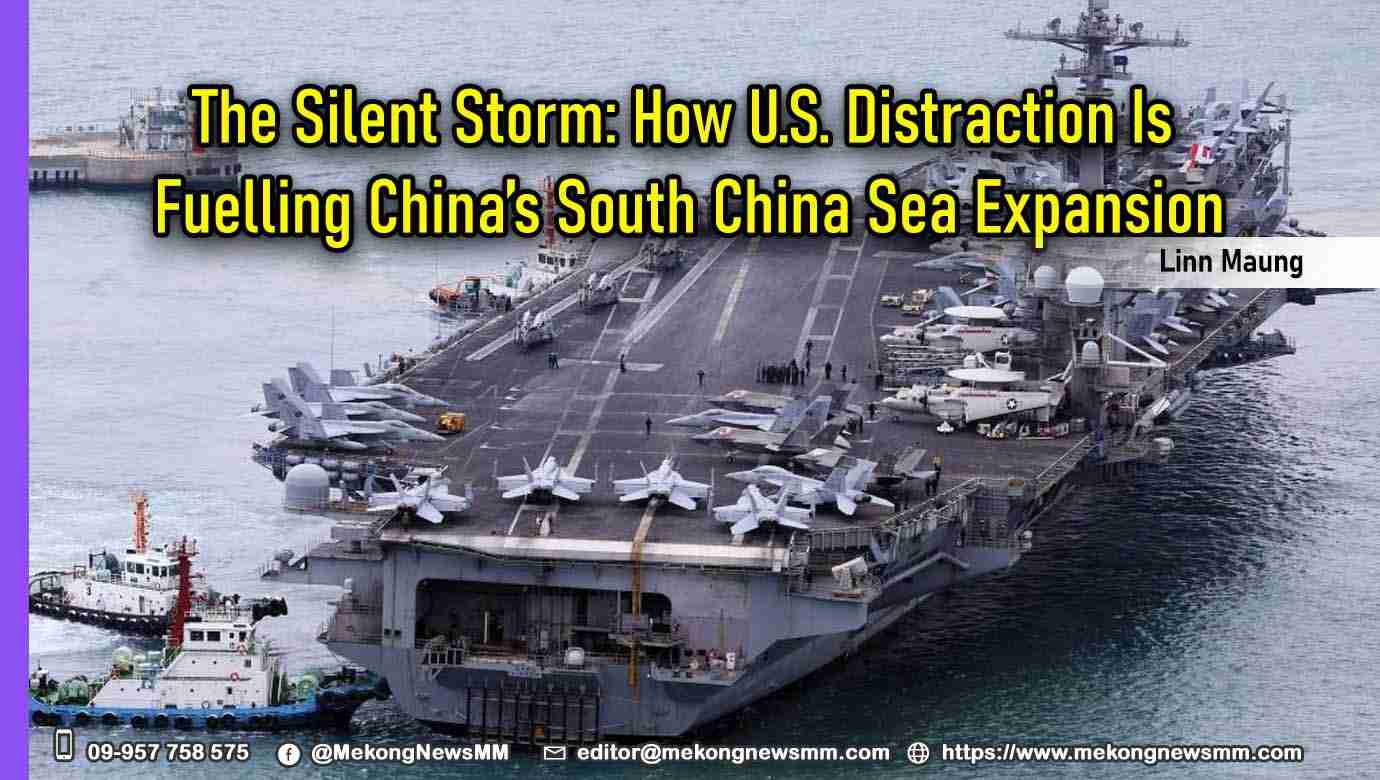
America’s redeployment of carrier strike groups and Marine Expeditionary Units to the Middle East has created a vacuum in the Pacific. The USS Abraham Lincoln and USS George Washington, once deterrents in the South China Sea, now patrol Middle Eastern waters. This leaves only the USS Theodore Roosevelt to shoulder the burden of deterrence across a vast theater that includes the Taiwan Strait, Korean Peninsula, and contested maritime zones.
The numbers tell the story: reconnaissance flights over the South China Sea have dropped by nearly 30% since late 2025. This decline in surveillance coincides with China’s accelerated dredging and land reclamation at Antelope Reef. Reduced U.S. presence is not just a tactical gap, it signals to Beijing that Washington’s gaze has shifted, offering China a window to entrench its dominance.
Antelope Reef: From Coral to Concrete
Satellite imagery from the European Space Agency and commercial providers reveals the scale of China’s ambition. What was once a modest outpost is now a burgeoning landmass spanning over six square kilometers. Engineers have carved straight edges into the reef, preparing foundations for a runway exceeding 2,700 meterslong enough to host fighter jets, surveillance aircraft, and heavy bombers. This expansion is not isolated. It mirrors earlier projects at Mischief Reef, Fiery Cross Reef, and Subi Reef, where China built hardened airstrips, radar installations, and missile batteries. Antelope Reef’s transformation signals Beijing’s intent to dominate the western Paracels, a corridor through which one‑third of global maritime trade flows.
China’s Island‑Grabbing Strategy
China’s tactics extend beyond Antelope Reef. Across the Spratlys and Paracels, Beijing has pursued a systematic campaign of “blue territory expansion.” By dredging coral reefs and erecting military infrastructure, China converts disputed features into de facto sovereign territory. China’s island‑building strategy in the South China Sea operates on two critical fronts. Legally, by physically occupying and fortifying disputed features, Beijing reinforces its sweeping “nine‑dash line” claims, despite the 2016 Hague tribunal ruling that invalidated them. Militarily, these artificial islands function as unsinkable aircraft carriers, enabling surveillance, electronic warfare, and anti‑access/area denial (A2/AD) capabilities. Alarmed by this expansion, Vietnam has accelerated reclamation across 21 Spratly features. Yet China’s scale dwarfs regional efforts, fuelling a domino effect of militarization that risks locking the South China Sea into perpetual conflict.
U.S. Vulnerabilities and Strategic Costs
Washington’s assumption that these outposts are vulnerable to precision strikes underestimates China’s resilience. Rapid runway repair units, electronic warfare systems, and missile stockpiles complicate U.S. strike options. Moreover, America’s missile shortages and overstretched logistics raise doubts about its ability to neutralize multiple fortified islands in a sustained conflict. By ceding initiative in the South China Sea, the United States faces immense strategic costs. China’s expanding anti‑access/area denial (A2/AD) network threatens to paralyze U.S. operations by restricting freedom of movement across the First Island Chain. This vacuum also risks eroding alliances, as Southeast Asian nations may hedge toward Beijing if they perceive Washington’s disengagement. Most critically, America’s credibility as the guarantor of a “free and open Indo‑Pacific” is undermined when it fails to counter China’s maritime expansion, signalling weakness and diminishing its global leadership at a time when regional stability depends on sustained U.S. presence.
A Pandora’s Box
Vietnam’s dredging of 13.4 square kilometers of reef since 2022 illustrates the reactive spiral triggered by China’s buildup. Other claimants, from the Philippines to Malaysia, may follow suit, escalating the arms race of artificial islands. This competitive fortification risks transforming the South China Sea into a militarized archipelago where diplomacy is drowned out by dredgers and warships.
U.S. Overlooking China’s Vicious Acts
The U.S. is not merely distracted—it is strategically overlooking the viciousness of China’s acts. Beijing’s reclamation is not benign infrastructure development; it is a deliberate attempt to seize territory, intimidate neighbours, and rewrite maritime law. By failing to maintain robust patrols and carrier presence, Washington tacitly enables this expansion. China’s actions amount to a creeping annexation of maritime space. Antelope Reef is emblematic of a broader pattern: seize, build, fortify, and normalize. Each artificial island becomes a brick in Beijing’s wall of control, eroding the sovereignty of neighbouring states and challenging international norms.
The Cost of Silence
The South China Sea is not a distant theatre it is a global artery of commerce and security. America’s silence and distraction risk ceding this artery to Beijing’s grip. Antelope Reef is more than a reef; it is a test of U.S. resolve, a symbol of China’s audacity, and a warning of what happens when vigilance falters. If Washington continues to overlook these acts, the Indo‑Pacific may awaken to a new reality: a South China Sea dominated not by freedom of navigation, but by the iron grip of Chinese reclamation.
References:
https://www.wsj.com/articles/china-antelope-reef-reclamation-south-china-sea-2026
https://www.scmp.com/news/china/military/article/3256789/us-reconnaissance-flights-drop-south-china-sea
https://amti.csis.org/antelope-reef-expansion-south-china-sea-2026
https://www.chathamhouse.org/publications/the-world-today/2026-03/vietnam-island-building-response-china
https://usni.org/fleet-tracker-2026
#MeKongNews