

~ Linn Maung ~
Environmental Policy or Financial Engineering?
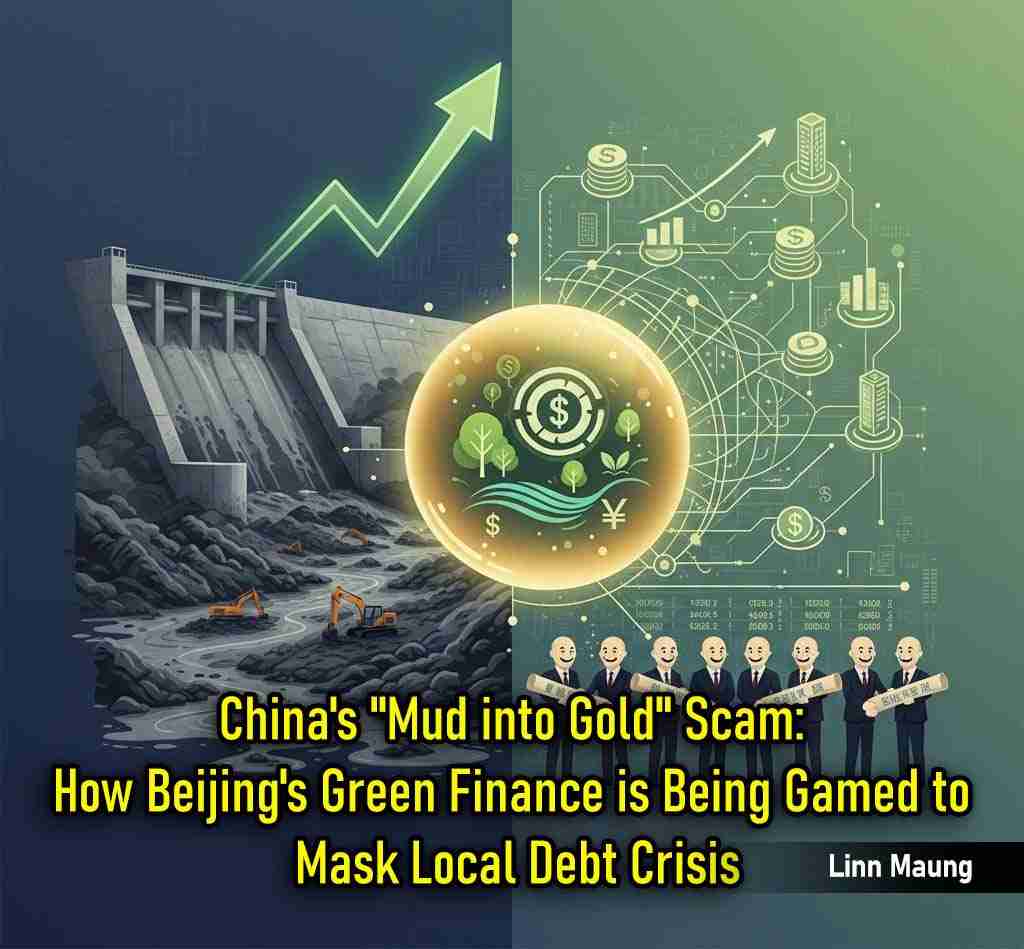
In a scheme that critics call “alchemy for the 21st century,” Chinese local governments are selling riverbed mud for billions of yuan, creating shell companies overnight, and using state-backed green loans to paper over a deepening debt crisis. The transactions, wrapped in the language of ecological innovation, reveal how Beijing’s push to “activate sleepy state assets” has become a tool for high-risk financial manipulation.
The $120 Million Mud Mountain
In August 2025, Heilongjiang Province auctioned 1.45 million cubic meters of reservoir sludge from the Dongfanghong Dam in Tieli City. The price: 61 million RMB ($8.5 million). Two months later, the same province sold 11 million cubic meters of sludge from two reservoirs in Yi’an County, Qiqihar. The price: 839 million RMB ($117 million)—nearly double the per-unit rate. Officials celebrated both deals as breakthroughs in China’s “ecological product value realization mechanism,” a policy framework designed to monetize environmental assets. But a closer examination shows the deals follow a pattern that has little to do with cleaning rivers and everything to do with creative accounting.
The buyers tell the real story. The Dongfanghong winner was an agricultural technology firm. The Qiqihar winner? A company called Qiqihar Zeyuan Environmental Protection Industry Co., Ltd., registered on October 10, 2025—just 13 days before the 839 million RMB transaction closed. Its registered capital: 270 million RMB. The purchase price: 839 million RMB. The company had zero track record in reservoir management or environmental remediation.
The Magic Trick: How to Turn Mud into Bank Loans
The key to understanding these transactions lies not in the mud, but in the financing. In the Dongfanghong case, the winning bidder immediately used its five-year “sludge operation rights” as collateral to secure a 45 million RMB “green loan” from the Agricultural Development Bank of China (ADBC). For the Qiqihar deal, local officials pre-arranged up to 900 million RMB in bank financing—effectively covering the entire purchase price.
This is the real playbook:
1. Local governments identify an “asset” (sludge) that is actually a liability needing expensive cleanup.
2. Officials commission valuation reports that declare the sludge “rich in nitrogen, phosphorus, and potassium,” worth 76 RMB per cubic meter as organic fertilizer.
3. A state-owned enterprise (SOE) is created specifically to bid on the asset, with no operational capacity but full government backing.
4. Banks, under pressure to meet green finance quotas, provide loans using the “future earnings rights” as collateral.
5. The government receives an immediate 839 million RMB windfall, recorded as “state-owned resource utilization income,” boosting its fiscal report card.
The result? Government revenue increases, the SoE gets assets and cheap loans, and the bank fulfils its green finance KPI. “Three birds with one stone,” as one official report boasted. The problem: The economics don’t add up. Industry analysts calculate that even if all the sludge could be converted to organic fertilizer, annual revenue would be around 100 million RMB. At that rate, the 839 million RMB investment—plus factory construction, equipment, and labour—would take a century to recoup, long after the 20-year rights expire. As one commentator noted: “The point isn’t digging up the mud, but financing upstream”.
“Three-Resources Monetization”: A Debt Crisis by Another Name
These sludge deals are pilot projects for a much larger policy push called “Three-Resources Monetization”: turn all state resources into assets, all assets into securities, and all funds into leverage. The policy emerged as China’s local governments face a perfect storm: plummeting land sale revenues (down 30-50% in many regions), mounting debt repayment pressure, and slowing tax growth. The solution? Creative balance-sheet engineering.
Hubei, Anhui, and Northeastern provinces have issued directives to “capitalize resources”—including forests, data, and even parking rights. The Heilongjiang sludge auctions were specifically framed as “landmark cases” for the “Longjiang Plan” to activate “sleeping state assets”. However, critics warn this is “Land Finance 2.0″—a replay of the dangerous debt-driven growth model that created China’s property bubble, now applied to ever-more-exotic assets.
The pattern is clear:
• Value an illiquid asset at an inflated price
• Transfer it to a government-controlled entity
• Use it to obtain bank loans
• Book the proceeds as current fiscal income
This shifts debt from government balance sheets to SoEs and banks. However, when the projects inevitably fail to generate promised returns, the loans become non-performing assets. Ultimately, it’s the central government—and Chinese taxpayers—who foot the bill.
Shell Companies and Regulatory Arbitrage
Qiqihar Zeyuan Environmental Protection Industry Co. Ltd. is not an isolated case. The company’s registration documents show it is 100% funded by the Qiqihar State-owned Assets Supervision and Administration Commission. This is a classic “platform company”—a hollow shell created solely to execute financial transactions; a practice China’s regulators have repeatedly tried to crack down on. The firm has no environmental track record, no technical expertise, and no realistic path to profitability.
Yet it was able to bid 839 million RMB for sludge rights. How? Because the real collateral wasn’t the mud—it was implicit government guarantee. Bankers know that local SoEs won’t be allowed to fail. The “green loan” label provides political cover and helps meet Beijing’s sustainability targets. Everyone in the chain—officials, bank executives, SOE managers—has incentives to complete the transaction, regardless of commercial viability. As one financial analyst wrote: “This is alchemy for a new age. With assets in one hand and capital in the other, what happens to the mud in between doesn’t seem to matter”.
Environmental Risks: A Ticking Time Bomb
Reservoir siltation is a genuine problem. China’s dams accumulate over 1 billion cubic meters of sediment annually, reducing flood-control capacity and threatening water security. However, the rush to monetize silt creates new dangers:
1. Pollution: Dredged silt often contains heavy metals and organic contaminants. Improper disposal can spread contamination to farmland and groundwater.
2. Technical shortcuts: Under pressure to generate returns, companies may dump silt illegally or skip costly treatment processes.
3. Monitoring gaps: Official reports celebrate the “fertilizer value” of silt but provide no public data on contaminant levels or environmental risk assessments.
This contrasts sharply with central government environmental inspections, which have repeatedly halted reservoir dredging projects in Guangxi and Yunnan over improper silt disposal and ecological risks. The Heilongjiang projects appear to receive a regulatory pass because they serve fiscal policy goals.
The Bigger Picture: A Systemic Crisis
The sludge auctions are symptoms of a deeper structural problem: China’s local governments are insolvent but prohibited from formally declaring bankruptcy. The “Three-Resources Monetization” policy provides political cover for increasingly desperate financial engineering.
Key warning signs:
• Valuation inflation: With no liquid market for sludge, prices are set by government-commissioned appraisals that serve political needs rather than economic reality.
• Moral hazard: Banks lend based on government connections, not project fundamentals, creating perverse incentives for risk-taking.
• Public cost, private gain: SOE executives and local officials get credit for “innovation” and hitting performance targets. When projects fail, the losses are socialized.
As one commentator bluntly stated: “This is a combine harvester for sheep. The federal government will bail out the banks, and all that money comes from ordinary people”.
Conclusion: Stop the Financial Juggling, Start Real Environmental Governance
The Heilongjiang sludge auctions expose how Beijing’s push for “ecological civilization” is being weaponized to mask fiscal decay. What is marketed as green innovation is, in reality, a sophisticated scheme to create phantom assets, extract bank loans, and defer debt accountability. To prevent this from becoming a systemic crisis, China must:
• Impose strict, independent environmental assessments on all resource-monetization projects, with public disclosure of contaminant data and risk analyses.
• Require genuine equity investment (not 100% leverage) for SoE bidders, ensuring skin in the game.
• Audit bank lending practices to green finance quotas aren’t incentivizing risky, politically-driven loans.
• Ban the creation of single-purpose shell companies for asset transactions, requiring bidders to demonstrate operational capacity.
• Separate environmental policy from fiscal rescue missions. Real ecological restoration requires patient capital and scientific rigor, not rushed financial engineering.
The mud at the bottom of Heilongjiang’s reservoirs is not gold. It’s a warning sign that China’s debt-addicted growth model is entering a dangerous new phase—one where even river sludge becomes collateral in a desperate gamble to keep the credit machine running. Until Beijing confronts the underlying fiscal crisis honestly, rather than disguising it with ever-more-creative asset bubbles, the “Longjiang Plan” will be remembered not as environmental innovation, but as a cautionary tale of how not to manage a debt crisis.
#MeKongNews