

~ Linn Maung ~
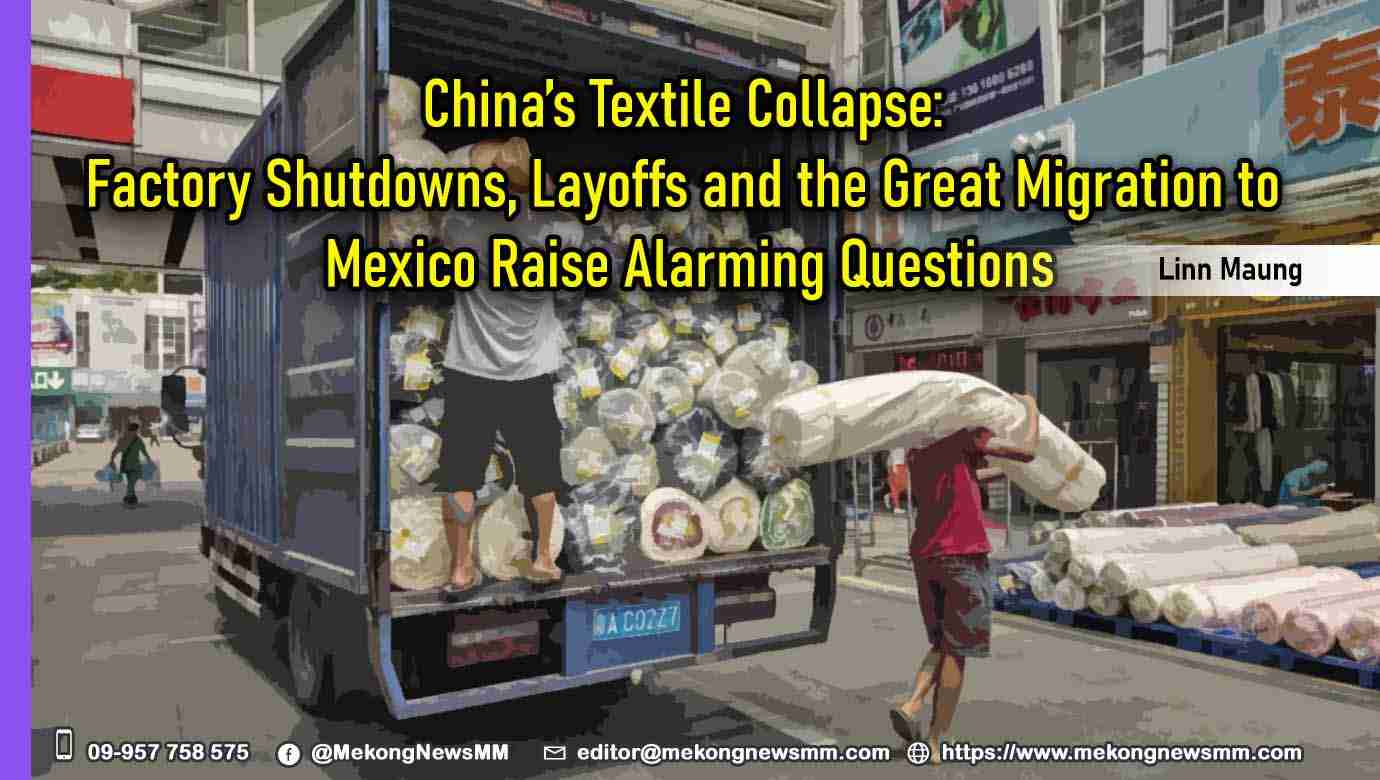
China’s textile industry, long regarded as the backbone of the world’s manufacturing supply chain, is showing unmistakable signs of stress. Once powered by endless export orders, abundant labour and a vast domestic market, the sector is now grappling with shrinking demand, factory closures, workforce reductions and an accelerating shift of production outside China’s borders. Behind the official statistics celebrating growth and profitability lies a very different story emerging from factory floors across Zhejiang, Guangzhou and other manufacturing hubs.
Recent industry estimates indicate that nearly 1,500 textile and apparel companies have dropped out of China’s official industrial-enterprise statistics during the first half of 2026. Reports suggest that the number of above-scale textile, clothing and apparel companies has fallen significantly, reflecting growing hardship within one of China’s most strategic industries. While leaving the statistical category does not automatically imply bankruptcy, it does indicate declining revenues, restructuring, or severe operational challenges.
The deeper concern is what is happening on the ground. Textile manufacturers are increasingly reporting smaller and shorter-term orders. Business owners who once received contracts lasting several months now face production schedules that stretch for only a few days at a time. Such volatility is making long-term planning nearly impossible and squeezing profit margins throughout the industry.
At the heart of the problem lies a persistent weakness in domestic demand. For years, Beijing sought to transition the Chinese economy from export dependence towards consumer-led growth. However, weak consumer confidence, a prolonged property sector crisis, economic uncertainty and slowing income growth have undermined household spending. The textile sector, heavily reliant on both domestic and overseas demand, has found itself trapped between declining local consumption and intensifying global competition.
As demand weakens, layoffs are becoming increasingly visible. Migrant workers who once flocked to China’s industrial zones are reportedly returning to their hometowns because factories can no longer guarantee stable employment. Numerous manufacturers have shortened work shifts, frozen recruitment, or reduced headcounts to survive. For thousands of families dependent on manufacturing wages, the slowdown is not merely an economic statistic. It is a direct threat to their livelihoods.
The closure of factories illustrates the seriousness of the situation. Reports surrounding Jiaxing Kanglong Textile Co. Ltd, a major foreign-invested manufacturer in Zhejiang Province, have attracted significant attention. According to industry reports, the company plans to halt production in China while transferring part of its denim manufacturing operations to Mexico Whether viewed as a business decision or a strategic supply chain adjustment, the move highlights a broader trend that has become impossible to ignore: manufacturing capacity is leaving China.
Mexico has emerged as one of the primary beneficiaries of this industrial migration. Its proximity to the United States, favourable trade arrangements under the USMCA framework and lower logistics costs make it an attractive destination for manufacturers seeking access to the North American market. For many companies, producing closer to consumers reduces transportation time, minimises tariff risks and provides greater supply chain flexibility.
Critics argue that China’s growing investment in manufacturing facilities in Mexico could eventually place additional pressure on the American textile sector. Rather than exporting products directly from China, some companies can establish production platforms closer to the United States market. While describing this as an intentional effort by Beijing to “destroy” the US textile industry would go beyond available evidence, many analysts believe Chinese-linked manufacturing expansion in Mexico is strategically aimed at preserving market access and maintaining competitiveness in North America. The result could be increased competitive pressure on American textile producers already struggling with cost disadvantages.
Ironically, the migration of production also exposes Beijing’s inability to fully retain industrial activity within its own borders. For decades, China attracted global manufacturers because of its low costs, massive labour force and unparalleled supply chain ecosystem. Today, factors such as rising labour costs, geopolitical tensions, slowing demand and changing trade realities are encouraging companies to diversify production elsewhere. The phenomenon suggests that even China’s powerful state apparatus cannot completely reverse unfavourable market dynamics.
The impact extends far beyond garment factories. The downturn is reverberating through the entire textile supply chain. Fibre producers, yarn manufacturers, dyeing facilities, finishing companies, logistics providers and apparel exporters are all experiencing the effects of reduced demand. When orders disappear at the retail end, shockwaves travel throughout the industrial ecosystem. Upstream suppliers lose business, inventories grow, cash flow deteriorates and investment slows.
What makes the situation even more controversial is the apparent disconnect between industry realities and official statistics. China’s National Bureau of Statistics recently reported increases in revenue and profits for above-scale textile enterprises. According to official data, the sector achieved modest revenue growth and stronger profitability during the first seven months of the year.
Yet many industry participants openly challenge these figures. Factory owners and employees argue that the reported growth bears little resemblance to conditions they are witnessing daily. They point to declining orders, idle production lines, mounting closures and persistent uncertainty. To them, claims of rising profitability appear disconnected from the severe pressures affecting manufacturers across the country.
This contradiction raises broader questions about transparency and economic reporting. If thousands of companies are struggling, workers are losing jobs and production capacity is moving overseas, how can official indicators simultaneously portray steady improvement? The answer may lie in the complexity of China’s economy, where large state-supported firms and stronger enterprises can offset weakness elsewhere. Nevertheless, the perception gap continues to fuel scepticism among business leaders and investors.
China’s textile industry is far more than a single manufacturing sector. It is a critical employer, a major exporter and an important indicator of the nation’s economic health. When factories close, workers lose jobs and production shifts abroad, the consequences extend well beyond balance sheets. They signal deeper structural problems within the economy itself.
Unless domestic demand strengthens and business confidence improves, the current trend may accelerate. More factories could shut down, more workers could be displaced and more production could relocate to countries offering lower costs and better market access. For an industry that once symbolised China’s manufacturing dominance, the textile sector now stands as a warning sign of the mounting economic challenges confronting the world’s second-largest economy.
References: https://www.theepochtimes.com/china/chinas-textile-industry-shrinks-as-factories-close-and-production-moves-overseas-6086063
https://www.aninews.in/news/world/asia/china8217s-textile-industry-faces-further-contraction-as-nearly-1500-firms-exit-official-data-pool20260913092346/
https://english.www.gov.cn/archive/statistics/202507/07/content_WS686b8b58c6d0868f4e8f3ea2.html
https://www.business-humanrights.org/en/latest-news/china-us-tariffs-trigger-export-slump-and-widespread-factory-closures/
https://www.fibre2fashion.com/news/textile-news/mexico-s-41-china-apparel-drop-hides-a-bigger-textile-story-312804-newsdetails.htm
https://www.statista.com/topics/7494/apparel-industry-in-china/
#MeKongNews