

~ Linn Maung ~
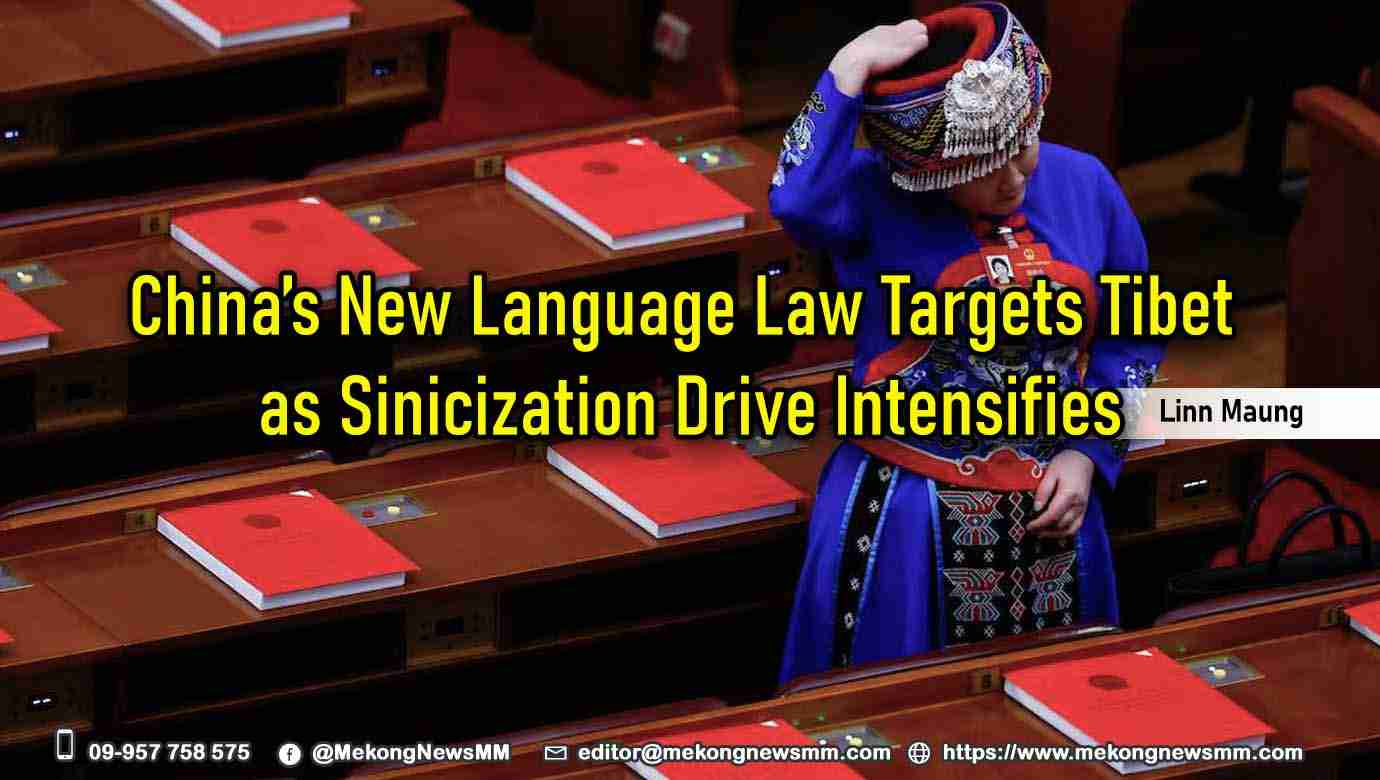
China is preparing to enact a sweeping new law that would sharply curtail the linguistic and cultural autonomy of ethnic minorities, marking the latest step in President Xi Jinping’s drive to reshape the country’s ethnic landscape through an aggressive policy of “Sinicisation.”
The legislation, expected to be introduced during the fourth session of the 14th National People’s Congress (NPC), which opened on March 5, would require ethnic minorities across the People’s Republic of China to adopt Mandarin Chinese as the principal language of instruction in schools and universities. In practice, it would dismantle long-standing provisions that allowed minority communities to use their own languages for teaching core subjects, a framework that had existed, at least formally, since the early decades of Communist rule under Mao Zedong.
Framed as the Law on Promoting Ethnic Unity and Progress, the measure is being presented by Beijing as a step toward strengthening “inter-ethnic harmony” and “forging a sense of community in the Chinese nation.” These phrases have become central to official discourse under Xi. In reality, critics argue that the legislation codifies an assimilationist agenda aimed squarely at Tibetans, Uyghurs and Mongolians, communities that Beijing increasingly views through a national security lens.
From Pluralism to Assimilation
China officially recognises 55 ethnic minority groups alongside the Han majority, which constitutes over 90 per cent of the country’s 1.4-billion population. The constitution also acknowledges multiple languages and scripts, reflecting the country’s vast cultural diversity.
For decades, at least on paper, Beijing maintained a system that allowed minority languages to serve as the medium of instruction in many schools, particularly in regions such as the Tibet Autonomous Region, Xinjiang, and Inner Mongolia.
The new legislation effectively overturns that framework. Minority languages may continue to be taught as subjects, but they will no longer serve as the language of instruction for key academic disciplines. For communities whose linguistic identity is inseparable from their cultural and religious traditions, the shift is widely seen as an existential challenge.
Benno Weiner, a historian of modern China and Inner Asia, has argued that the move signals a fundamental ideological shift in Beijing’s ethnic policy.
“The law overturns the multicultural promises upon which the People’s Republic was founded,” he notes. Instead of “unity through difference,” the state now appears to be pursuing “unity through sameness.”
Security Lens on Diversity
The transformation reflects Xi’s leadership’s worldview, which increasingly equates cultural distinctiveness with political vulnerability.
In regions such as Xinjiang, home to the predominantly Muslim Uyghur population, Beijing has already imposed sweeping restrictions on religious practice, education and social life. International rights groups have documented the existence of mass detention centres and extensive surveillance networks designed to reshape the cultural identity of the region.
In Tibet, authorities have steadily tightened control over monasteries and the Tibetan-language education system. In Inner Mongolia, protests erupted in 2020 after schools were ordered to replace Mongolian-language textbooks with Mandarin ones for several subjects.
Seen against this backdrop, the new law appears less an administrative reform than the legal consolidation of a policy already unfolding on the ground.
Criminalising Dissent
The proposed law goes beyond education policy. It introduces provisions that threaten legal action against individuals or organisations, within China or abroad, accused of undermining “national unity” or encouraging “separatism.”
One clause specifically warns that “ethnic unity and progress shall not be interfered with by external forces under the guise of ethnicity, religion or human rights.” The language reflects Beijing’s growing sensitivity to international criticism of its policies in Tibet and Xinjiang, where the United States and several European countries have enacted legislation condemning human rights abuses.
Another controversial provision asserts that only the state has the authority to promote “symbols of Chinese civilisation.” These symbols may be used in public architecture, exhibitions, place names and cultural events, effectively placing cultural expression under tighter ideological supervision.
For minority communities, analysts warn, such provisions could criminalise even peaceful expressions of cultural identity if they are perceived as diverging from the official narrative.
Rewriting Ethnic Policy
The fact that Xi personally presided over a Politburo meeting last year that called for the law’s rapid adoption underscores its political importance. It is unusual for the Chinese leadership to publicly highlight deliberations over specific legislation, suggesting the measure forms part of a broader strategic agenda.
That agenda reflects Xi’s conviction that the Communist Party must forge a more unified national identity to guard against internal fragmentation. In Beijing’s view, China’s frontier regions, stretching from Tibet in the southwest to Xinjiang in the northwest and Inner Mongolia in the north, are not merely cultural peripheries but strategic buffers.
By embedding assimilation policies in law, the leadership appears determined to ensure that linguistic and cultural integration becomes irreversible.
The Stakes for Minority Cultures
For Tibetans, Uyghurs and Mongolians, language has long been the cornerstone of identity, linking education, religion and collective memory.
Removing it from classrooms risks accelerating the erosion of traditions that have survived for centuries despite waves of political upheaval.
Critics warn that the new law signals the final abandonment of the limited pluralism that once characterised China’s ethnic policy. Instead, it institutionalises a model in which diversity is tolerated only so long as it conforms to a state-defined notion of “Chinese civilisation.”
The consequence may be a paradox: a campaign intended to strengthen national unity could deepen alienation in the very regions Beijing seeks to stabilise.
#MeKongNews