

~ Linn Maung ~
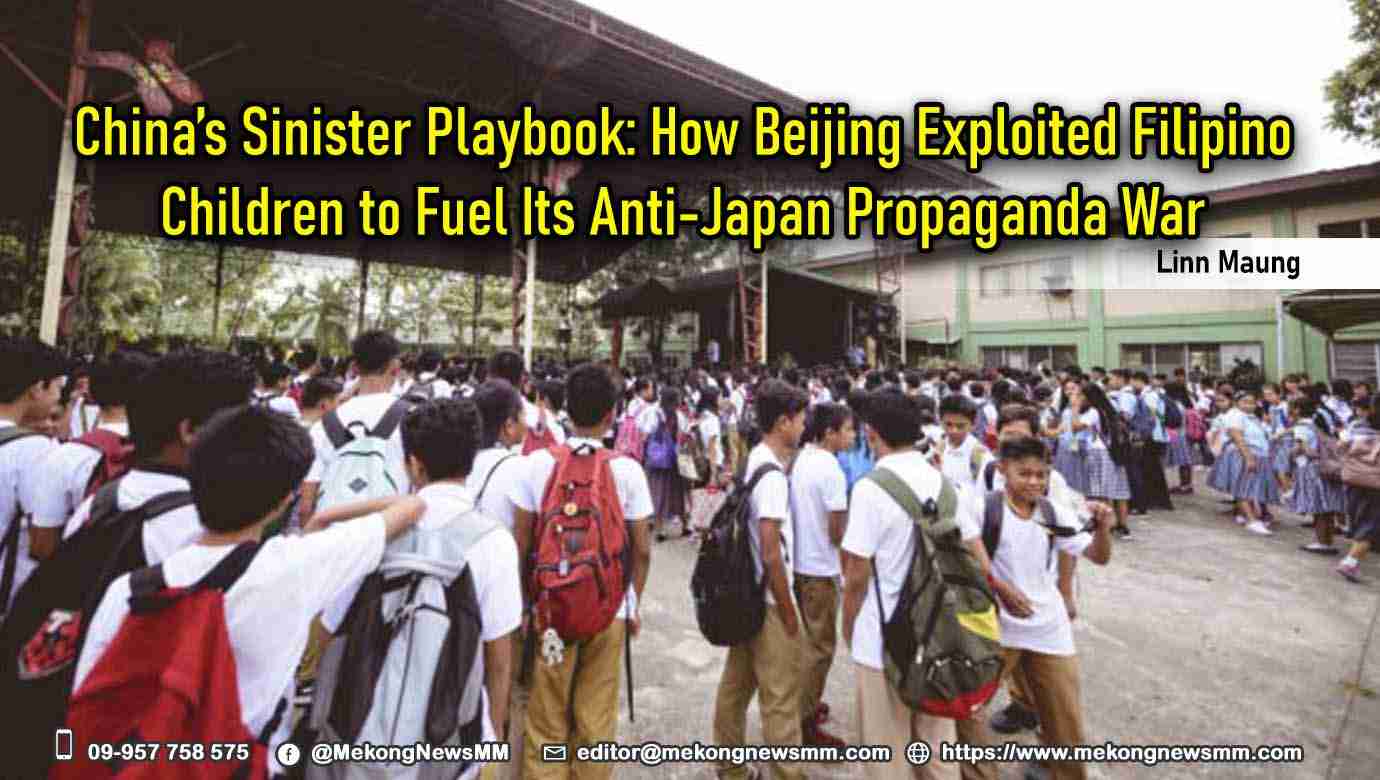
China’s latest manoeuvre in the Philippines has exposed the ruthless depths of its propaganda machine. By cloaking political messaging in the guise of an academic contest, Beijing has attempted to transform classrooms into ideological battlegrounds. Filipino children, unaware of the geopolitical weight behind their essays, were subtly pushed to echo narratives hostile to Japan and dismissive of Taiwan’s legitimacy. This was not an exercise in education but a calculated intrusion into the minds of the young, exploiting innocence to advance authoritarian ambitions. The episode underscores how the CCP is willing to corrupt even the sanctity of childhood to serve its crooked agenda.
A Deceptive Invitation
In early 2025, the Philippine Department of Education’s National Capital Region office circulated Regional Letter No. 107, S.2025, inviting public school students to join an essay contest commemorating the 80th anniversary of the Allied victory over Imperial Japan. On the surface, this looked like a harmless enrichment activity. Teachers saw it as an opportunity to engage students in history and writing. Yet beneath the official veneer lay a carefully orchestrated propaganda exercise designed to manipulate children into echoing Beijing’s hostile stance toward Japan and Taiwan.
Propaganda Disguised as Education
The contest was organized by a local Chinese-Filipino education group with ties to Beijing. The themecelebrating victory over Japanwas deliberately chosen to revive wartime grievances and redirect them toward contemporary geopolitical rivals. Essays were expected to frame Japan as a continuing threat, while Taiwan was subtly cast as illegitimate. By embedding these narratives in a school-sanctioned activity, the CCP sought to normalize its worldview among Filipino youth, turning classrooms into ideological battlegrounds.
Innocence as a Political Tool
Children were not merely participants; they were instruments. The CCP’s strategy hinged on the credibility of youthful voices. When children write essays condemning Japan or questioning Taiwan’s sovereignty, the message appears organic, untainted by politics. This veneer of innocence makes propaganda more persuasive, both domestically and internationally. It is a cynical exploitation of trust: parents, teachers, and communities assume educational activities are benign, while in reality they are being co-opted into Beijing’s geopolitical machinery.
The Broader Pattern of CCP Manipulation
This incident is not isolated. China has long used cultural exchanges, scholarships, and Confucius Institutes to shape narratives abroad. What makes the Filipino essay contest particularly insidious is its direct targeting of minors. By embedding propaganda in school systems, the CCP bypasses traditional diplomatic channels and plants seeds of hostility in the next generation. This mirrors tactics seen in Xinjiang, where children are separated from families to absorb state ideology, and in Hong Kong, where education reforms aim to erase dissenting historical perspectives.
Implications for the Philippines
The Philippines, already caught in the crossfire of South China Sea disputes, now faces a subtler form of aggression: ideological infiltration. By exploiting Filipino children, Beijing undermines Philippine sovereignty in education and manipulates public sentiment against Japan, a key regional ally. This tactic risks sowing division within Philippine society, weakening its ability to form coherent foreign policy aligned with democratic partners.
Why Japan and Taiwan Were Targets
Japan represents a strategic counterbalance to China in Asia, while Taiwan embodies the democratic alternative Beijing fears most. By reviving wartime narratives, the CCP attempts to delegitimize Japan’s role as a stabilizing force in the region. Simultaneously, by framing Taiwan as a “traitorous province,” it seeks to erode sympathy for its democratic struggle. Filipino children, unknowingly, were asked to carry these messages forward, lending them moral weight through youthful voices.
A Crooked Motive Behind Innocent Faces
The CCP’s motives are clear: to weaponize history, manipulate innocence, and advance its geopolitical agenda under the guise of education. This is not about remembrance or reconciliationit is about manufacturing consent. By exploiting children, Beijing demonstrates its willingness to corrupt even the most sacred spaces of learning to achieve its ends.
Conclusion
The 2025 Filipino essay contest stands as a stark reminder of how authoritarian regimes weaponize education. It is a warning to democracies worldwide: vigilance is required not only on battlefields and trade routes but also in classrooms. The CCP’s crooked motives, masked by the innocence of children, reveal the depth of its propaganda machinery. The Philippinesand indeed the worldmust recognize this exploitation for what it is: a violation of trust, sovereignty, and the sanctity of childhood.
Sources:
https://thediplomat.com/2026/03/how-china-exploited-filipino-children-for-its-2025-anti-japan-propaganda-campaign
How China Exploited Filipino Children for Its 2025 Anti-Japan Propaganda Campaign
https://www.scmp.com/news/asia/article/china-propaganda-strategy-education
https://www.brookings.edu/articles/chinas-global-propaganda-and-education-influence
https://www.csis.org/analysis/chinas-education-propaganda-and-foreign-policy