~ Linn Maung ~
Behind China’s imposing government buildings and ambitious economic targets, a growing fiscal strain is reshaping the relationship between local authorities, businesses and ordinary citizens.
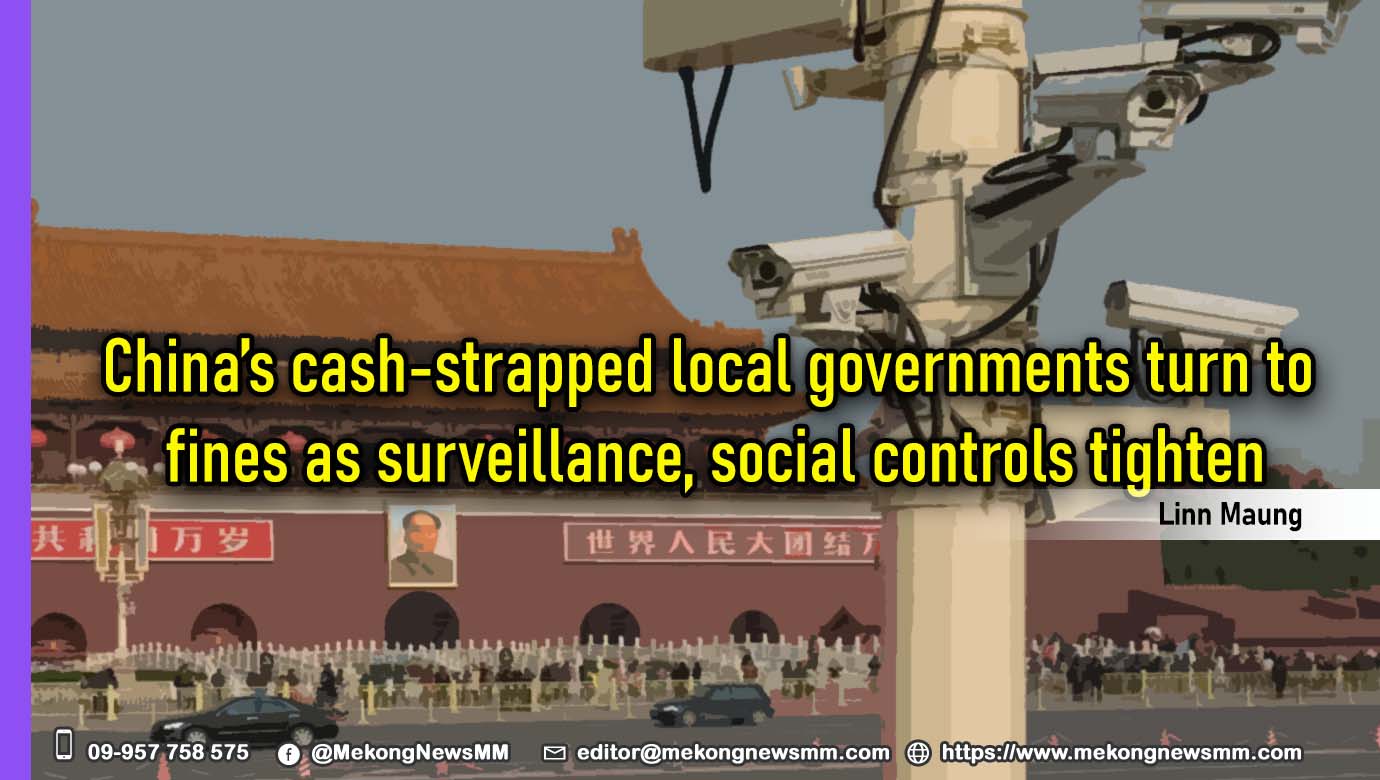
As the property downturn continues to drain an important source of public revenue, local governments are facing mounting pressure to meet their financial obligations. At the same time, authorities are tightening their scrutiny of online speech, neighbourhood activities, petitioners and travel.
The combination has raised questions about how Beijing’s demands for financial discipline and social stability are being enforced at the local level.
Businesses face increasingly intensive tax scrutiny and administrative penalties, while residents report more detailed checks on their personal lives. The extent of individual cases varies, but recent research and official figures reveal the scale of the financial pressures confronting local administrations.
For critics, the concern is that fiscal enforcement and social control are increasingly operating side by side, placing additional pressure on businesses and citizens already dealing with economic uncertainty.
Property slump deepens fiscal pressure
China’s local governments have long relied on land sales and property-related revenues to finance infrastructure, public services and development projects.
That model has come under sustained pressure since the property crisis began in 2021, leaving local authorities with fewer resources while debt obligations and expenditure responsibilities remain substantial.
The International Monetary Fund’s September 2026 assessment of China’s local government finances estimated that official local government and local government financing vehicle debt stood at approximately 90 percent of gross domestic product at the end of 2025.
The report highlighted the consequences of falling land-related income, mounting repayment pressures and the weaknesses of financing arrangements that had supported local investment for years.
The latest fiscal figures underline the continuing strain.
According to figures released by China’s Ministry of Finance and reported by Reuters on 23 October, government revenue increased by 5.1 percent year on year to 17.2 trillion yuan in the first nine months of 2026.
Tax revenue rose by 6.1 percent, while non-tax revenue increased by just 1.2 percent.
Yet revenue from land sales fell by 27.9 percent over the same period, demonstrating that the property downturn continues to undermine a crucial source of local government funding.
Authorities accelerated the issuance of special-purpose bonds, with net issuance reaching 3.56 trillion yuan during the first nine months, equivalent to 81 percent of the annual quota.
The figures describe a difficult imbalance: the wider government revenue total is growing, but local authorities remain exposed to the decline of a revenue stream that once financed a substantial share of their activities.
Fines become a fiscal flashpoint
As conventional revenue sources weaken, administrative fines and asset confiscations have attracted greater attention.
A study reported by Caixin Global on 25 August examined data from 279 Chinese prefecture-level cities between 2015 and 2023.
It found that fines and confiscations accounted for an average of 14.7 percent of local non-tax revenue, with their contribution increasing over the period.
The researchers also found that higher penalty levels were associated with fewer new businesses entering certain sectors, including hospitality, agriculture and residential services.
Research published in Public Budgeting & Finance in September reached a related conclusion.
Analysing approximately 20 million administrative penalty records, the study found that cities more exposed to the collapse in land-transfer revenue imposed higher per-capita fines.
National revenue from fines and confiscations reached 394 billion yuan in 2023, equivalent to about 1.8 percent of general public budget revenue.
These findings do not establish that every fine is imposed to raise money.
They do, however, document a relationship between fiscal pressure and the use of administrative penalties, raising concerns about the incentives facing officials when local budgets come under strain.
The issue has also surfaced in government investigations. In May, China’s Ministry of Justice reported that a nationwide campaign had corrected more than 66,000 cases involving improper law enforcement against businesses since March 2025.
The cases included excessive inspections, arbitrary fines and fees, irregular asset seizures, cross-regional enforcement and practices described as profit-driven. Authorities said businesses had recovered 30.7 billion yuan in losses.
The campaign indicates that concerns about enforcement practices have reached the central authorities themselves. It also illustrates the tension between local revenue pressures and Beijing’s stated efforts to prevent arbitrary penalties from undermining business activity.
Tax inspections target businesses
Tax collection has become another point of pressure. A report by the South China Morning Post on 24 April described a wider enforcement drive against tax evasion, including cases involving gold jewellery, alcoholic beverages and refined oil.
The State Taxation Administration disclosed eight cases in which businesses had allegedly understated revenues, diverted sales proceeds into personal accounts or used shell companies to reduce tax liabilities.
The cases resulted in back-tax payments, fines and late-payment penalties; the largest individual penalty in the group reached 40 million yuan.
Separately, The Epoch Times reported in August that a person familiar with local government operations alleged that some officials manipulated tax records to create additional liabilities for businesses.
The source claimed that discrepancies could lead to demands for back taxes and late fees.
The newspaper said it could not independently verify the insider’s account. The allegations therefore cannot be treated as established evidence of a widespread practice.
They nevertheless reflect the concerns raised by some business operators over the use of tax audits and retrospective assessments during a period of fiscal stress.
The broader economic consequences matter because private businesses are already navigating weaker demand, intense competition and uncertainty surrounding the property sector.
When tax investigations or penalties become unpredictable, businesses may face additional pressure over cash flow, investment and employment.
Protests keep authorities on alert
Financial pressure is unfolding alongside persistent public grievances. China’s property crisis has left some homebuyers waiting for unfinished homes, while workers and small businesses have faced disputes involving unpaid wages and outstanding payments.
Freedom House’s China Dissent Monitor recorded 846 dissent events during the second quarter of 2026, including protests led by homeowners, workers and rural residents.
Homeowners accounted for 36 percent of the recorded events, workers 24 percent and rural residents 18 percent.
The organisation noted that the number of documented events was 45 percent lower than in the same quarter of 2025, while warning that intensified censorship could have reduced the amount of protest information available.
These figures represent documented events rather than a complete count of all protests in China.
The figures follow the nationwide demonstrations of late 2022, commonly known as the White Paper Movement, when anger over stringent COVID-19 restrictions spilled into public protests in several cities.
Although the immediate circumstances differed, the demonstrations remain a significant example of how local grievances can develop into broader expressions of public dissent.
An insider quoted by The Epoch Times alleged that local authorities had been instructed to pursue a dual approach: addressing financial problems while preventing unrest.
The source also claimed that officials were paying particular attention to petitioners and dissidents.
The newspaper did not independently verify those claims.
However, documented protests over housing, employment and other economic grievances provide context for the authorities’ continuing emphasis on maintaining social stability.
Neighbourhood surveillance grows more intrusive
At the community level, China’s grid-management system gives local personnel responsibility for monitoring small neighbourhood areas and gathering information about residents.
Authorities use the system for administrative work, including registering migrant residents and rental properties.
A Shanghai resident identified by The Epoch Times as Wang said checks had become more frequent during the second half of 2026.
He alleged that officials were gathering more detailed information about people staying in homes, family circumstances and household disputes, in addition to identity and contact details.
Wang’s account is an individual testimony and does not establish that identical practices are occurring nationwide. Nevertheless, it illustrates the concerns that can arise when routine neighbourhood administration expands into questions about private family life.
The same report cited claims that authorities in Hebei had instructed lower-level administrations to strengthen monitoring of online commentary.
The allegations could not be independently confirmed, but they point to the broader intersection between local administration, information monitoring and efforts to identify potential sources of unrest.
Exit rules widen state discretion
Travel restrictions have added another dimension to the debate. China’s new State Council Regulations on Exit-Entry Administration took effect on September 15.
They allow authorities to restrict departures in specified circumstances, including certain violations involving export controls or technology trade that are considered threats to national industrial or technological security.
The rules also require applicants to provide truthful information about their travel purposes and allow authorities to withhold notification of some restrictions where disclosure could affect national security or a criminal investigation.
The Chinese government says the regulations protect national sovereignty, security and development interests.
Human Rights Watch, however, warned on 16 September that broadly defined grounds for restricting travel could expand arbitrary exit bans and weaken procedural safeguards.
The new provisions do not establish that authorities are restricting travel simply to prevent people from spending money overseas, as alleged by the anonymous insider cited by The Epoch Times.
Their documented scope concerns exit-entry administration and security-related restrictions. The distinction is important when assessing claims about the government’s motives.
Financial strain meets social control
China’s local fiscal difficulties are measurable in falling land-sale revenue, substantial debt and growing reliance on alternative sources of income.
Research linking financial pressure to administrative penalties, together with official efforts to correct improper enforcement, has brought renewed attention to the risks businesses face when local authorities operate under budget constraints.
At the same time, recorded protests over housing and wages, reports of more intensive neighbourhood checks and the expansion of legal grounds for travel restrictions illustrate the wider environment in which local administrations operate.
The available evidence does not establish a single nationwide policy linking every tax investigation or surveillance measure to a deliberate effort to suppress dissent.
It does show that financial enforcement and social-stability management are both significant features of China’s current administrative landscape.
For businesses, the immediate concern is the cost and predictability of enforcement.
For residents, it is the reach of official scrutiny into their online activity, movement and private lives. As the property downturn continues to weigh on local finances, the pressure surrounding both issues remains a central part of China’s economic and political story.
#MeKongNews