


~ Linn Maung ~
China’s ambitions in Southeast Asia are no longer limited to trade agreements, railway projects and investment packages. Across the region, Beijing is steadily expanding its influence through infrastructure, logistics networks and strategic partnerships which increasingly carry military significance. The latest example has emerged in Laos, where a newly operational China-Laos Joint Support and Training Centre at Ban Keun, located north of Vientiane, has raised serious questions about whether China has secured its first fully fledged military foothold in mainland Southeast Asia. What was once presented as a development partnership now appears to be evolving into something much broader and far more consequential.
The Ban Keun facility, inaugurated in September 2026, sits at a historically strategic location that was once used by American forces during the Vietnam War era. Satellite imagery has revealed rapid construction activity, military vehicles and China-made aircraft at the site. While Beijing insists the facility is designed to train Lao Air Force pilots and enhance bilateral defence cooperation, many regional security analysts see a different picture taking shape. They point to the possibility of future runway extensions, intelligence-gathering capabilities and a permanent Chinese military presence that could significantly expand Beijing’s reach deep into mainland Southeast Asia.
For years, the Chinese Communist Party (CCP) has promoted the Belt and Road Initiative (BRI) as a purely economic undertaking intended to improve connectivity and stimulate growth. However, developments in Laos, Cambodia and Myanmar suggest that the initiative may also serve a strategic geopolitical purpose. Infrastructure projects financed by Chinese state banks often place recipient countries under significant debt obligations while simultaneously increasing their dependence on Beijing for investment, trade and development assistance. Over time, that dependence can translate into political leverage and strategic concessions.
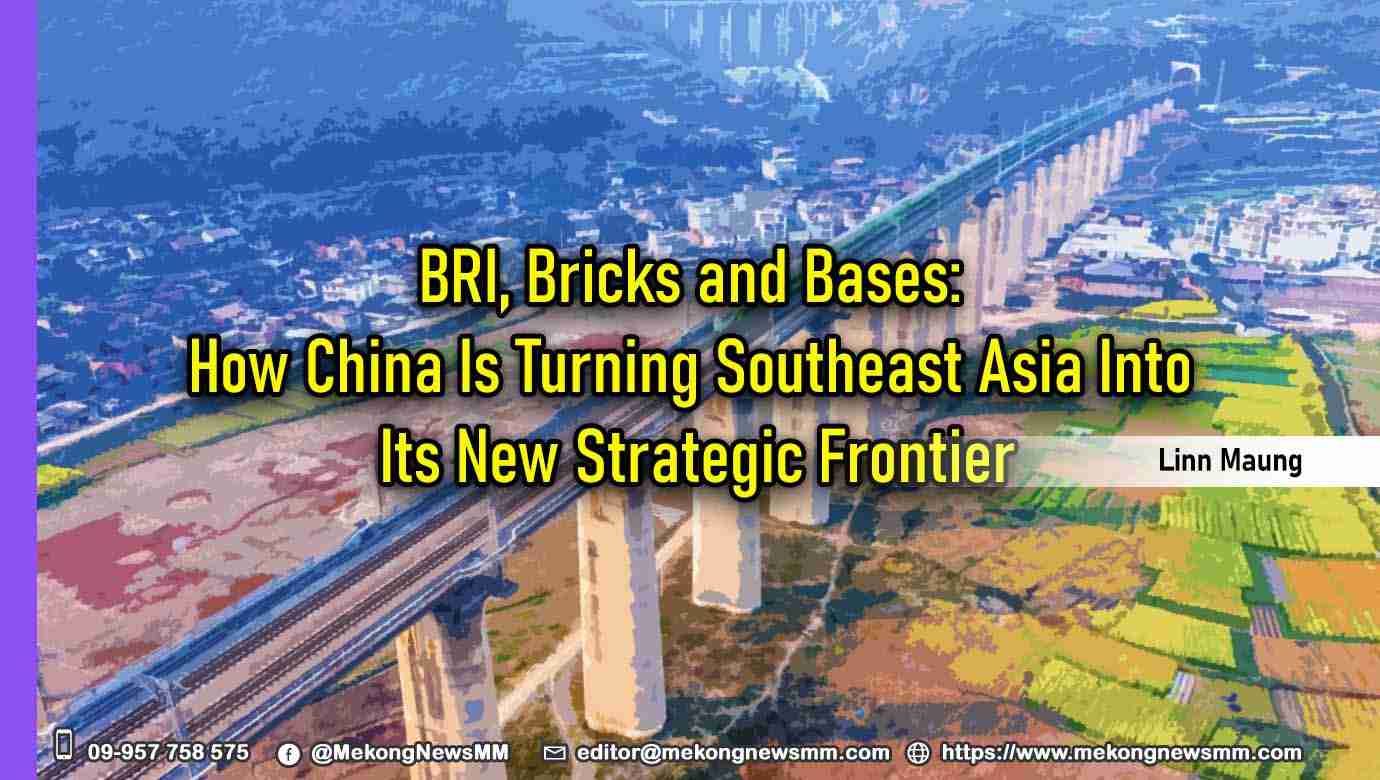
Laos provides perhaps the clearest example of this phenomenon. With a population of roughly eight million people and one of Southeast Asia’s weakest economies, Laos has become deeply integrated into China’s economic orbit. China-backed hydropower projects dominate the country’s electricity ambitions. Chinese firms hold extensive mining concessions covering copper, gold and rare earth resources. Large agricultural zones producing bananas, rubber and timber are heavily linked to Chinese markets. Most visibly, the China-Laos high-speed railway, costing approximately US$6 billion, has become the flagship symbol of Beijing’s influence. Promoted as a transformational project, the railways is yet to deliver the level of economic benefits originally promised to ordinary Lao citizens while dramatically increasing China’s strategic presence within the country.
The pattern visible in Laos can also be seen in Cambodia. Over the last decade, China has become Cambodia’s largest investor and its closest political and economic partner. Massive Chinese financing has flowed into roads, ports, industrial zones and energy projects. At the same time, the Ream Naval Base on Cambodia’s Gulf of Thailand coastline has become a focal point of international concern. Although Cambodian authorities repeatedly deny hosting a foreign military base, China-funded renovations have transformed the facility into a much larger strategic asset. The establishment of a China-Cambodia Joint Support and Training Centre at the facility has fuelled suspicions that Beijing is creating a network of military access points under the cover of bilateral cooperation.
Myanmar represents another critical component of China’s regional strategy. The China-Myanmar Economic Corridor, a major BRI project, provides Beijing with access to the Bay of Bengal and the Indian Ocean. The deep-sea port at Kyaukphyu, together with energy pipelines stretching more than 2,000 kilometres into China’s Yunnan Province, offers a valuable alternative to the vulnerable Malacca Strait shipping route. Following the 2021 military coup and the subsequent deterioration in relations between Myanmar and Western nations, China’s influence has expanded once again. New legal mechanisms allowing foreign security companies to operate inside Myanmar have further increased concerns about China’s growing security footprint in the country.
The broader strategic logic is increasingly difficult to ignore. Instead of overtly establishing traditional overseas military bases, Beijing appears to be creating what could be described as a “dual-use network.” Ports, airfields, logistics hubs and training centres are presented as civilian or cooperative projects yet many possess the infrastructure necessary for future military applications. This approach allows China to avoid direct political backlash while gradually strengthening its operational capabilities across an increasingly important geopolitical theatre.
Compounding the issue is the relative inability of regional and Western institutions to counterbalance China’s advance. ASEAN’s consensus-based decision-making process often limits the organisation’s effectiveness in addressing strategic concerns involving member states. Meanwhile, the United States and its allies have struggled to present compelling economic alternatives capable of matching the scale and speed of Chinese investment. In many developing nations, immediate infrastructure needs frequently outweigh long-term geopolitical considerations.
The CCP’s approach in Southeast Asia demonstrates how economic power can be transformed into strategic influence. Railways become leverage. Ports become access points. Development projects become instruments of statecraft. What began as an ambitious infrastructure initiative in 2013 is increasingly viewed by critics as a sophisticated mechanism for expanding Chinese influence far beyond commerce.
The significance of Laos extends far beyond its borders. If the Ban Keun facility ultimately evolves into a durable Chinese military outpost, it will mark a major milestone in Beijing’s regional ambitions. More importantly, it will reinforce the growing perception that the Belt and Road Initiative is not merely about building roads, railways and bridges, it is also about building influence, dependence and, ultimately, strategic power across Southeast Asia. The question now confronting the region is not whether China’s footprint is expanding but how far that expansion will go before meaningful resistance emerges.
References:
https://www.reuters.com/world/asia-pacific/china-laos-joint-support-training-centre-2026
https://www.reuters.com/world/asia-pacific/cambodia-ream-naval-base-china-expansion-2025
Belt and Road paving way for China’s military presence in SE Asia
#MeKongNews