

~ Linn Maung ~
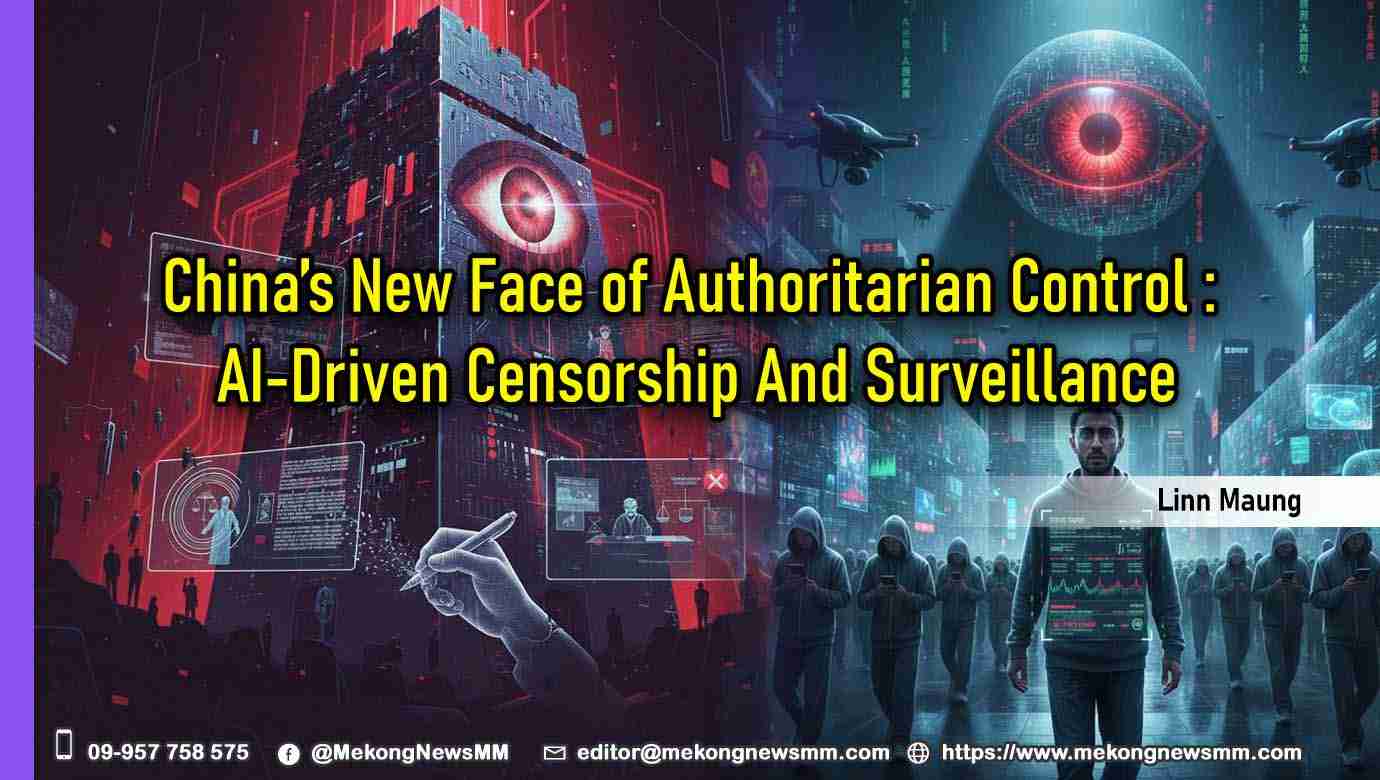
Artificial intelligence is often framed as a kind of ideological chameleon, absorbing the assumptions and incentives of whoever deploys it. That framing works, but it also lets governments off the hook. A more revealing lens is to treat AI as an accelerant: it doesn’t invent new political instincts so much as it turbocharges the ones already in place. Applied to the People’s Republic of China, this means AI doesn’t simply “mirror” authoritarian habits—it multiplies and systematizes them. The result isn’t a digitally updated version of old controls; it is a fundamentally new architecture of governance built on prediction, pre-emption, and political asymmetry.
The Chinese state’s desire to police information isn’t new. The Great Firewall, keyword filters, and sprawling human moderation teams were early attempts to enforce ideological coherence across a continent-sized population. What changed is not motive but the physics of control. Manual censorship is labor-intensive and slow. AI introduces something the security apparatus never had before: tempo. Machine-learning systems now review oceans of text, images, audio, and video in real time, constantly updated to recognize coded language, visual metaphors, meme dialects, and shifting slang. This isn’t your grandfather’s censorship apparatus; it’s an adaptive system that learns from the user base it polices.
That adaptability matters because repression usually becomes inefficient at large scale. Autocrats historically struggle when dissent decentralizes. AI reverses the asymmetry by allowing the state to centralize faster than citizens can innovate. Linguistic creativity—satire, metaphor, wordplay—used to be a kind of citizen countermeasure. Now it’s fuel. Every workaround becomes new training data. A regime that once swatted individual sparks of dissent can now vacuum the air for smoke.
The more unsettling frontier isn’t broad-based censorship but precision targeting. Independent research, notably by the Australian Strategic Policy Institute (ASPI), has documented the development of AI models tuned specifically to monitor minority languages such as Uyghur, Tibetan, and Mongolian. This is not accidental by-product. These languages historically created pockets of cultural privacy—spaces where oral tradition, religious instruction, or community coordination could occur beyond Mandarin-centric systems. AI erases that buffer. When an algorithm is trained to ingest and interpret minority linguistic cues, it becomes a political sensor, an instrument for detecting cultural autonomy itself.
Human-rights organizations, including Human Rights Watch, have spent years documenting coercive policies in Xinjiang—from mass detention to forced assimilation programs. The arrival of AI doesn’t create the repression, but it makes it scalable, searchable, and silent. A security official no longer needs to understand Uyghur discourse to monitor it; a model does the listening. This collapse of linguistic distance marks a turning point: a state once limited by its inability to fully penetrate minority communication now holds a tool designed precisely for that task.
The legal system offers an equally instructive case study. “Smart courts,” algorithmic risk assessments, and AI-assisted sentencing are marketed as neutral improvements to judicial efficiency. Yet neutrality means little in an environment where courts are subordinate to party oversight. Algorithms trained on politically skewed datasets inherit those distortions the way sediment gathers in a river delta. The danger is not only biased outputs; it is the veneer of scientific legitimacy layered atop predetermined outcomes. The opacity of machine-learning models compounds the issue. A defendant may receive an unfavorable risk score without ever learning which features counted against them—a kind of digital oracle whose authority cannot be questioned because its logic cannot be inspected.
International analysts have argued that these systems do even worse than entrench existing biases; they transform political priorities into automated routines. When algorithmic recommendations align with state ideology by design, the legal process becomes a choreography: steps performed, boxes checked, justice pre-decided. The presumption of innocence is not overturned; it’s bypassed.
Beyond China’s borders, the global ramifications of this model are already visible. Beijing exports surveillance platforms, data-fusion centers, and “smart city” packages to governments hungry for control but lacking either the technical capacity or the domestic legitimacy to build such systems themselves. Technology, after all, is a geopolitical vector. States that adopt Chinese-built infrastructure often inherit its underlying assumptions—centralized monitoring, weak privacy protections, and an emphasis on pre-emptive security. In countries with fragile rule of law, this can shift the balance between citizens and the state in ways that will take decades to unwind.
Critics sometimes describe these exports as “digital authoritarianism,” but that phrase undersells the ambition. What China is exporting is not simply hardware or software—it is a theory of governance in which visibility flows upward, accountability does not flow downward, and politics becomes a matter of managing populations rather than representing them. AI fortifies that theory by making it operational at scale.
The temptation is to treat this as a story about China alone, but technologies of prediction and control rarely stay confined to their first adopters. The more seamless the integration of AI into state power becomes, the more attractive the model may appear to leaders who prioritize stability over liberty. That is the global risk: not that the world becomes China, but that China proves the feasibility of a system in which repression is quiet, automated, and mathematically optimized.
History is full of heavy-handed regimes that fell under their own weight. What makes AI-enabled authoritarianism uniquely troubling is its potential to lighten that weight—reducing the friction, the cost, and even the visibility of coercion. When repression becomes computational, it becomes less legible. And when it becomes less legible, it becomes more durable.
The debate ahead is not merely technical. It cuts to the question of whether the tools shaping the twenty-first century will amplify human agency or erode it. The Chinese case offers both a warning and a preview: technology may not invent new forms of power, but it can refine them with unsettling precision.
References (text links)
Australian Strategic Policy Institute – The Party’s AI: How China’s New AI Systems Are Reshaping Human Rights
https://www.aspi.org.au/report/the-partys-ai-how-chinas-new-ai-systems-are-reshaping-human-rights
The Washington Post – How China Is Using AI to Extend Censorship and Surveillance
https://www.washingtonpost.com/world/2025/12/01/china-ai-censorship-surveillance/
National Endowment for Democracy – Data-Centric Authoritarianism and China’s Global Tech Ambitions
https://www.ned.org/data-centric-authoritarianism-how-chinas-development-of-frontier-technologies-could-globalize-repression-2/
Human Rights Watch – China’s Algorithms of Repression
https://www.hrw.org/news/2022/12/06/chinas-algorithms-repression
Reuters – Coverage on Chinese online censorship and AI-enabled monitoring
https://www.reuters.com/world/china/
#MeKongNews