

~ Linn Maung ~
China is providing critical military support to the military junta in Myanmar to help it brutally eliminate the ethnic armies and massacre the ethnic minorities. Beijing’s aim is to protect its economic interests in Myanmar by propping up the junta government, but this has exposed the nature of the communist rulers of China: cynics with utter disregard for human rights.
Myanmar holds strategic importance for China due to its abundant resources, favourable geographical position along the Bay of Bengal and a long and settled land border with China.
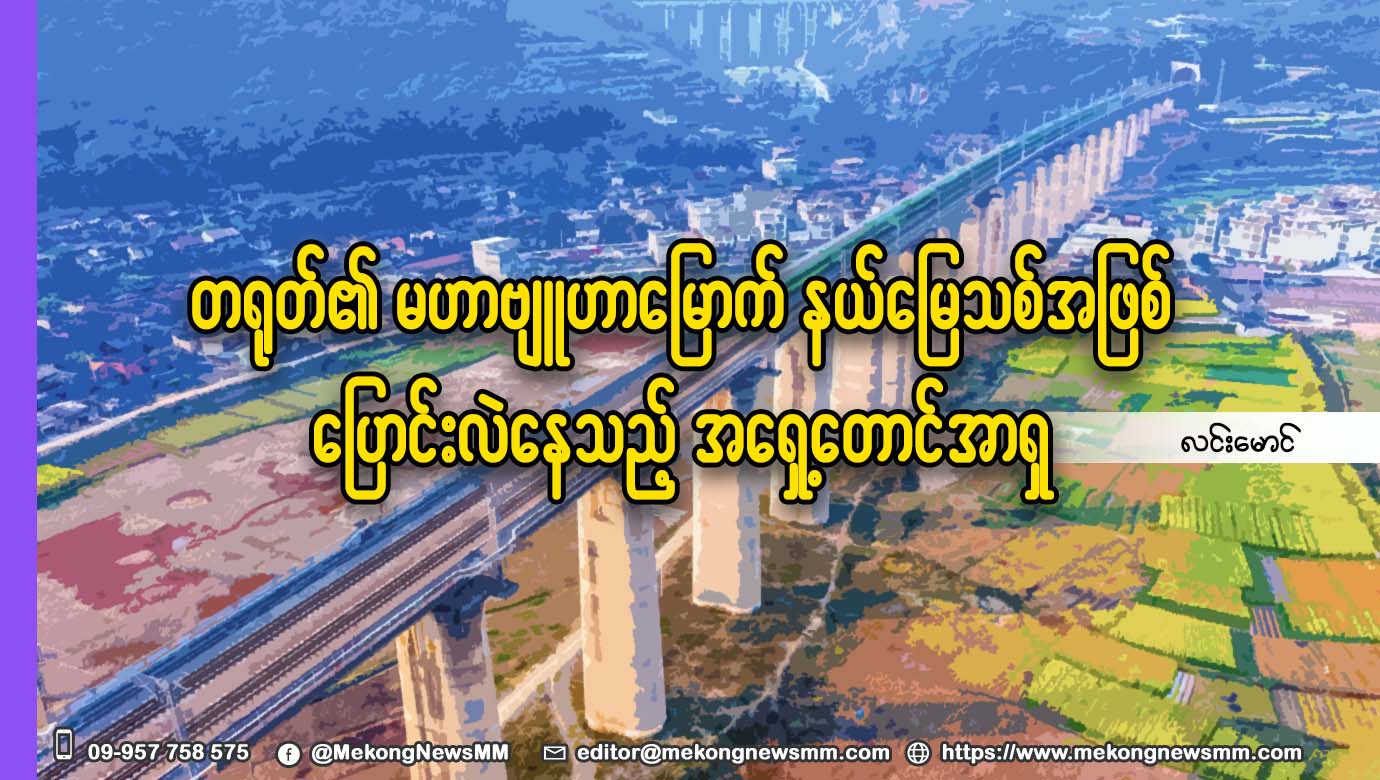
The China Myanmar Economic Corridor has been conceived by Beijing to gain access to the Bay of Bengal and through it to the Indian Ocean region. The land border with Myanmar helps cost-effective overland oil transport to China. Myanmar is a main source of China for rare earths, essential for hi-tech industries. Major Chinese investments under the CMEC include the Kyaukphyu Special Economic Zone with an investment of $1.5 billion, the Mee Lin Gyaing LNG project, with investment of $2.5 billion and the New Yangon City Project with investment of $1.5 billion.
“Beijing, rebel leaders and analysts say, is protecting its financial interests in Myanmar that are worth billions of dollars, including pipelines to transport crude oil and natural gas nearly 500 miles from the Bay of Bengal to China, and infrastructure projects being built under the Belt and Road Initiative umbrella,” a New York Times report says.
Facing mounting losses in its battles with rebel armies owing allegiance to different ethnic minority groups in Myanmar and widespread resistance from pro-democracy groups, the junta was on the verge of collapse. The military junta is cleverly capitalizing on this anxiety of Beijing to protect its investments. Senior General Min Aung Hlaing, the then Prime Minister of Myanmar, had repeatedly asserted that only military rule can protect the strategic ambitions of China in Myanmar. He has revived BRI projects which had been suspended for a long time because of concerns relating to environment and debt; like the highly controversial Myitsone Dam.
The aim of the junta government is also trying to get Chinese support to hold sham elections in December. Since the coup, the junta has banned 40 political parties, including Aung San Suu Kyi’s party the National League for Democracy, and jailed around 30,000 political prisoners.
In late 2024, the Burmese state media announced a $3 billion Chinese aid package, camouflaged as “economic support and reconstruction assistance.” This aid is believed to have strengthened the military logistics of the junta. Drones and surveillance systems made in China have improved the capacity of the army to target rebel positions.
According to a report quoting the Special Advisory Council for Myanmar, an independent group of human rights experts founded by three UN officials, bombs made with Chinese support are being used by the Myanmar Air Force to attack civilians indiscriminately. The report dated July 16, 2025, and titled ‘Factory of Death: China’s Support for the Myanmar Military’s Production of Aerial Bombs,’ says: “A Chinese state-owned company is enabling the Myanmar military to manufacture aerial bombs at a secretive weapons factory in central Myanmar. The aerial bombs are used in significant numbers by the Myanmar Air Force in airstrikes against civilians — attacks that may meet the threshold of serious international crimes.”
With Chinese military assistance, the junta has escalated its attacks on civilians, targeting camps of displaced persons, schools and markets with precision. In the infamous bombardment of the Pa Zi Gyi village in the Sagaing Division in December 2023, 155 people, including children, were killed. In a bombing on a Buddhist monastery in Sagaing last July, 23 people were killed. Then again, in October last, 24 people were killed when an army para-glider dropped two bombs on a crowd assembled in central Myanmar for a Buddhist festival.
Beijing started helping the military junta with the weapons and platforms necessary for aerial attacks when rebel armies took control of the town of Kyaukme, on the main trade route from the Chinese border to the rest of Myanmar. The capture of the town by the Ta’ang National Liberation Army was seen as a pivotal victory for the opposition, foretelling the collapse of the military junta. With Chinese help, however, it took in October the army only three weeks to recapture Kyaukme. Large portions of the town were flattened by daily air strikes with 500-pound bombs, while drones and the artillery hit rebel positions outside the town.
China has been stepping up pressure on other ethnic armies to stop fighting the military junta. Last April, under pressure from Beijing, the Myanmar National Democratic Alliance Army (MNDAA) abandoned the city of Lashio, the capital of the northern Shaan state and a much coveted prize. The ethnic armies captured it in 2024. “Rebel leaders say the sudden withdrawal was the result of pressure from China which has been intervening in the civil war to help the junta,” the New York Times report says.
The MNDAA has since agreed to stop fighting the junta. The United Wa State Army has bowed to Chinese demands and agreed to stop supplying weapons and ammunition to other rebel armies in Myanmar. These groups operate along the border of China and need regular access to Chinese territories to function. China has only to close the border gates and detain a few of their leaders to arm-twist them.
Beijing’s policy of helping the junta government to remain in power to protect the Chinese investments in Myanmar will finally boomerang against the China Myanmar Economic Corridor as Beijing is antagonizing public opinion in Myanmar against China by facilitating the massacre of the civilian population. Beijing’s policy of prioritizing its economic and strategic interests at the expense of human rights has already fuelled a national outrage in Myanmar against China.
On March 21 last a silent procession was taken out at Lashio by people displaced in the conflict; opposing the involvement of China in brokering peace talks between the MNDAA and the junta. The protesters distributed posters asking China to cease its support for the military regime, an evidence of the growing anti-China sentiment in Myanmar. On October 18, 2024, the Chinese consulate in Mandalay was the target of an explosion. In May 2023, at Letpadaung in the Sagaing Division demonstrators burnt Chinese flags and photos of then Chinese Foreign Minister Qin Gang. In Mandalay, protestors demanded that China respect the voice of the people. On social media, there were hate speeches targeting China.
Even in 2021, soon after the military coup staged by the junta with perceived Chinese assistance, protestors had chanted “China’s gas pipeline will be burnt” and “Chinese business out.” With much of the Chinese investments spread in the ethnic minority areas of Myanmar and the oil pipeline running through unguarded areas, analysts say Beijing must also worry about the possible long-term backlash of its policy of propping up the junta.
#MeKongNews