


~ Linn Maung ~
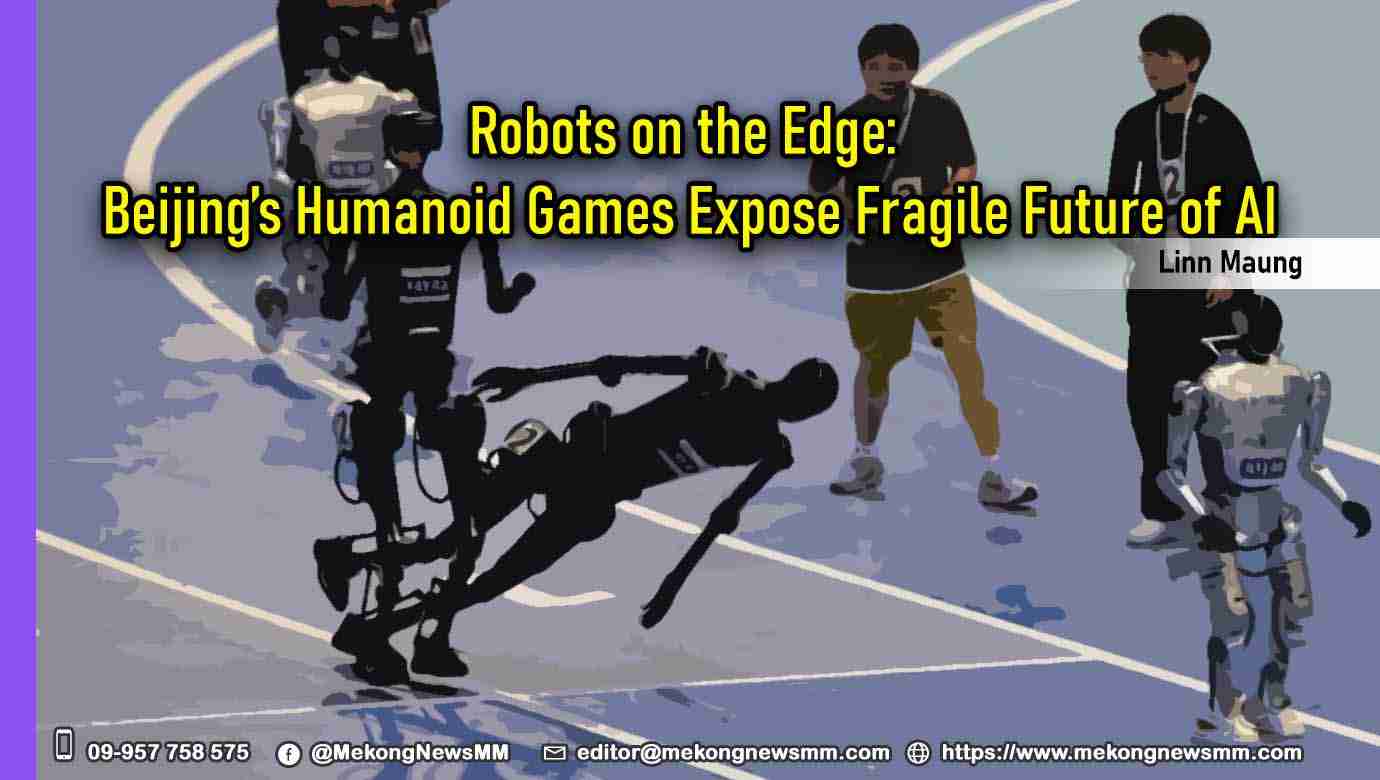
The spectacle of humanoid robots stumbling, sparking, and collapsing at Beijing’s National Speed Skating Oval during the ‘World Humanoid Robot Games’ has become a viral symbol of both ambition and fragility in China’s robotics industry. What was intended as a showcase of cutting-edge innovation instead highlighted glaring weaknesses in design, autonomy, and commercialization.
During high-speed running tests, robots repeatedly failed to correct direction, crashed into barriers, and even emitted sparks from damaged joints. The sight of machines tumbling backward or sliding across the track drew laughter and disbelief from audiences. Despite days of preparation, accidents dominated the opening events, with robots unable to slow down, turn properly, or maintain balance. The rules requiring full autonomy no remote control during acceleration or sprinting exposed how far current designs remain from reliable performance.
The failures were not confined to racing. Fighting matches saw robots missing targets, throwing punches into empty space, or collapsing mid-kick. Demonstrations at the World Robot Conference were equally chaotic, with robots losing control, flailing wildly, and requiring multiple staff members to restrain them. Investors left disappointed, describing the exhibition as noisy, repetitive, and lacking differentiated technologies.
This is not an isolated embarrassment. Chinese robots have repeatedly faltered in public demonstrations from collapsing during product launches to mishandling simple delivery tasks. A viral video showed a domestic robot failing to pick up a food bag, stepping on it instead, while its operator frantically pressed remote controls. In stark contrast, Tesla’s humanoid robot demonstrated fluid dexterity by scooping popcorn into a cup and handing it back smoothly, underscoring a yawning technological gap. As one commentator noted, “The difference is not one generation, but a different species.”
The industry’s shortcomings are compounded by commercialization struggles. Robot-operated vending booths in Chinese cities reveal how even basic tasks handing over bottled water take minutes instead of seconds. Robots often misidentify products, damage shelves, or shut down when faced with minor disruptions. Repair costs remain high, sometimes equalling half a worker’s monthly salary, undermining the argument that robots reduce labour costs. Underlying these failures is a deeper structural issue: policy-driven hype. The humanoid robot sector has become entangled with national strategy, with the CCP identifying robotics as a priority in its innovation agenda. Companies like Unitry Technology have benefited from waves of state support and speculative capital. Its IPO on the Shanghai Stock Exchange initially surged sevenfold before collapsing by over 40% within days, exposing the fragility of investor confidence. The turnover rate of 85% on its first trading day reflected speculative frenzy rather than sustainable growth.
Critics argue that the industry is being propelled more by political image-building than genuine technological readiness. Robots are deployed in malls, exhibitions, and conferences to signal progress, but their limited functionality and frequent failures erode credibility. As one investor bluntly stated, the sector suffers from “excessive marketing and lack of differentiation.”
The broader implications are sobering. If robots cannot reliably perform simple tasks like delivering food or vending drinks, their ability to revolutionize elder care, manufacturing, or defence remains distant. Analysts warn that valuations are inflated by assumptions of eventual general-purpose capabilities. Should these expectations fail, the industry could face a severe correction.
Yet, the stakes are not merely commercial. Robotics has become a geopolitical frontier, with Beijing betting heavily on AI and embodied intelligence to compete with the United States. The failures at the World Humanoid Robot Games reveal the gap between ambition and reality. While the sector is hot, its trajectory is uncertain, hinging on whether companies can move beyond spectacle to deliver meaningful, scalable applications.
The lesson is clear: robotics cannot be advanced through hype alone. Without breakthroughs in autonomy, dexterity, and adaptability, humanoid robots risk remaining expensive novelties rather than transformative tools. The viral images of robots crashing, sparking, and collapsing may be entertaining, but they also serve as a stark reminder of how far the industry must go before it can credibly claim to reshape society.
References
https://www.scmp.com/news/china/science/article/robot-games-chaos-highlights-chinas-tech-gap
https://asiatimes.com/2026/08/chinas-humanoid-robot-industry-faces-critical-test
https://www.reuters.com/technology/china-robotics-ipo-collapse-investor-concerns-2026-08-21
https://www.ft.com/content/china-ai-robotics-national-strategy
#MeKongNews