


~ Linn Maung ~
When Fox News anchor Bret Baier stepped onto a Beijing street during U.S. President Donald Trump’s visit to China, he found himself surrounded by cameras. Within minutes, his driver received a traffic fine by text message for illegal parking. The episode was mundane by Chinese standards, but it offered a glimpse into a system unlike anything seen elsewhere in the world: a state-built digital architecture designed to monitor, identify, and ultimately shape the behaviour of nearly 1.4 billion people.
China’s surveillance state did not emerge overnight. It was constructed in layers over two decades through a series of centrally directed programs that fused policing, artificial intelligence, biometric databases, and neighbourhood-level monitoring into a single ecosystem of control.
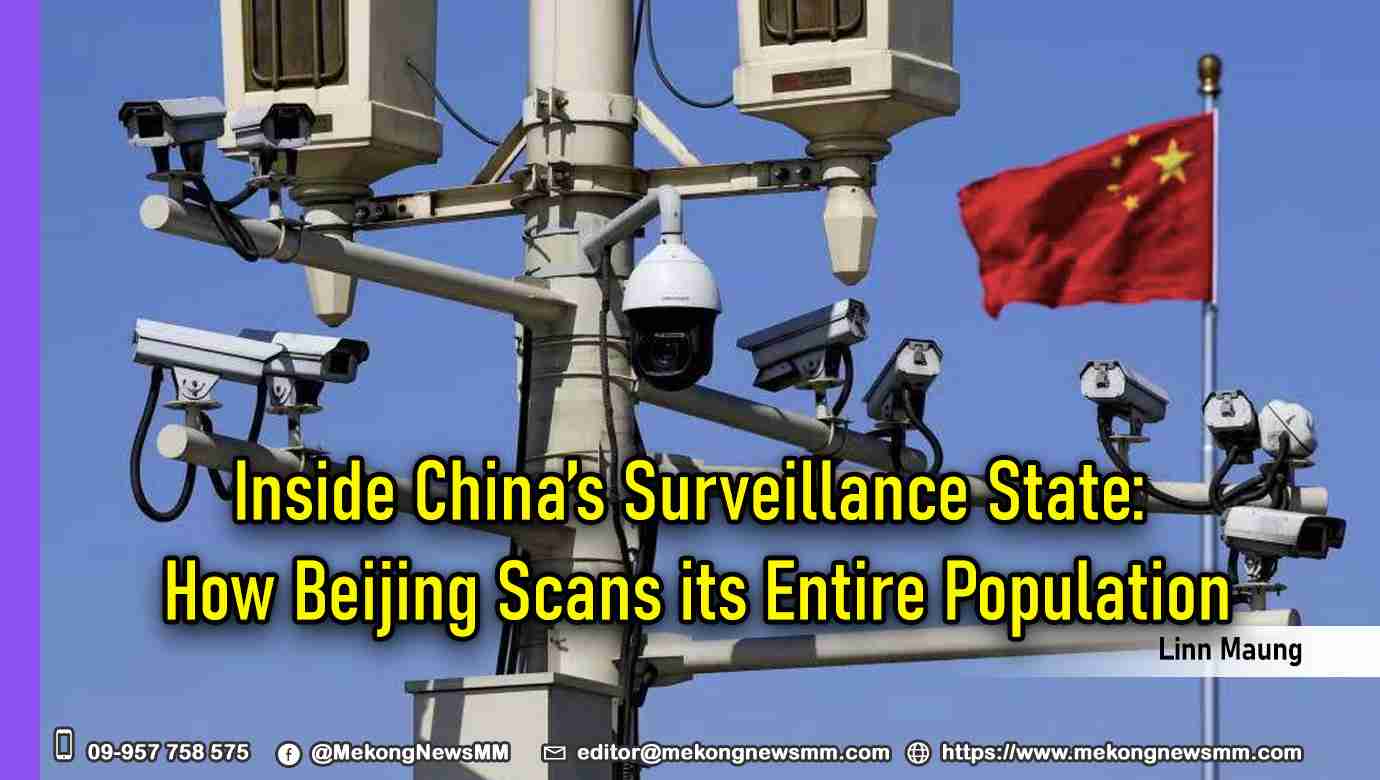
The foundation was laid in 2005 with the launch of the Skynet project by China’s Ministry of Public Security. Its purpose was straightforward: blanket urban China with cameras linked to facial recognition systems and national identity databases. By 2017, according to research by the Centre for Security and Emerging Technology, the network had expanded to 176 million cameras monitoring roads, transport hubs, schools, and commercial centres around the clock.
Chinese state media later boasted that the system could scan the country’s entire population in a second. Experts questioned the technical exaggeration, but not the direction of travel. Even if such claims were inflated, the capabilities were already formidable.
The next phase marked a decisive shift, from surveillance of public spaces to surveillance of society itself.
In 2015, Beijing launched the Sharp Eyes program, overseen by the National Development and Reform Commission and several security agencies. Official directives called for “full coverage” of public areas with “no blind spots.” But Sharp Eyes went beyond government cameras. It integrated private residential systems, commercial CCTV feeds, rural television networks, and local monitoring terminals into a unified police-accessible platform.
The logic was unmistakable: every citizen could become both watcher and watched.
In some pilot regions, residents were even able to access live surveillance feeds through television set-top boxes and directly alert police to “suspicious” behaviour. The CCP’s objective was not simply crime prevention. It was predictive governance, identifying potential unrest before it materialised.
Artificial intelligence has since transformed the scale and speed of that ambition. A 2025 report by the Australian Strategic Policy Institute estimated China may now operate as many as 600 million surveillance cameras. AI-powered systems are increasingly capable of recognising faces, tracking movement patterns, flagging crowd formations, and automatically alerting law enforcement.
Chinese authorities are also embedding AI deeper into governance structures. Courts have been instructed to develop AI-assisted judicial systems, while local governments are experimenting with drones and automated policing systems capable of “intelligent law enforcement.”
What distinguishes China’s surveillance system is not merely its size, but its political purpose.
The network functions as a tool for enforcing ideological conformity and suppressing dissent. Religious groups, dissidents, ethnic minorities, and activists remain primary targets. A 2025 assessment by the UK Home Office documented cases of practitioners of Falun Gong being identified and detained through camera surveillance while peacefully practising or distributing information.
It is where China’s surveillance model fundamentally differs from those in democratic societies. In liberal democracies, surveillance is at least nominally constrained by courts, media scrutiny, privacy laws, and political opposition. In China, the surveillance apparatus operates under the direct authority of the Communist Party, with few meaningful checks.
The implications are now global.
Chinese companies such as Hikvision and Dahua Technology dominate the international surveillance camera market, exporting not only hardware but also operational models to governments across Asia, Africa, and Latin America. Rights groups warn that Beijing is effectively exporting techno-authoritarianism alongside its technology.
China’s surveillance state is no longer just a domestic security project. It has become a governing philosophy, one where data, AI, and omnipresent monitoring are used to maintain political control at an unprecedented scale.
For visitors like Baier, the system is striking. For Chinese citizens, it is increasingly inescapable.
#MeKongNews