


~ Linn Maung ~
China’s decision to steer unemployed university graduates back into vocational education has triggered a sharp public backlash, exposing growing frustration among young people who were raised to believe that academic degrees guaranteed upward mobility and stable white-collar careers.
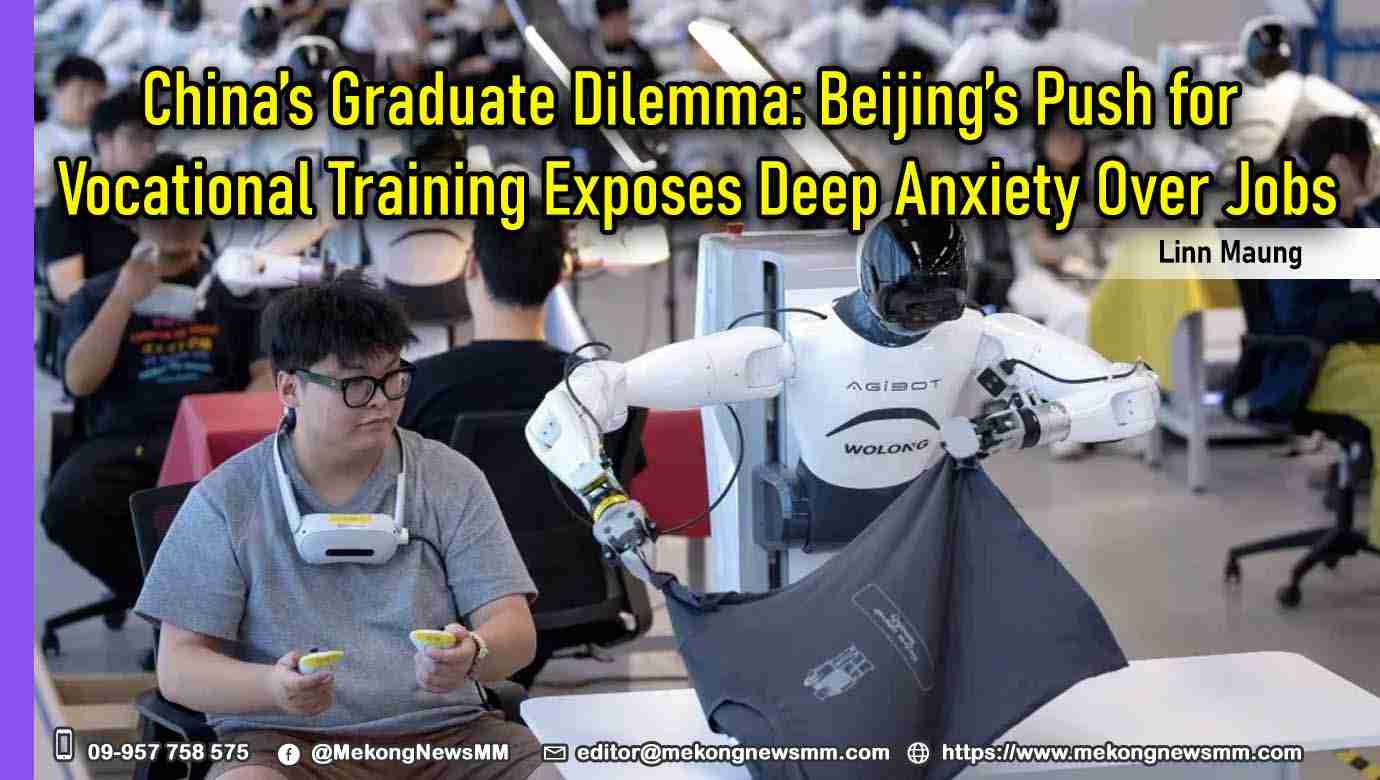
Facing mounting youth unemployment and an economy struggling to generate enough high-quality jobs, Beijing has announced an ambitious plan to retrain one million young people this year in sectors such as artificial intelligence, robotics, advanced manufacturing, new energy vehicles and the “low-altitude economy” – a term increasingly used in China for drone-related industries and urban air mobility.
At the centre of the controversy is a proposal encouraging university graduates to enrol in technical schools to acquire more industry-oriented skills. Officials argue the initiative is aimed at bridging the widening gap between academic education and labour market demand. But for many young Chinese, the policy feels less like an opportunity and more like an admission that years spent pursuing degrees may no longer hold the value they once did.
The reaction on Chinese social media has been telling. One widely shared comment summed up the mood: “I worked my way from vocational school to an undergraduate degree and then a master’s, only to be told to go back to a technical college.”
The resentment reflects a deeper structural problem confronting China’s economy. For decades, higher education was marketed as the surest path into the middle class. Families invested enormous sums in tutoring, university admissions and postgraduate education, believing academic credentials would unlock secure jobs in finance, technology, government or large corporations.
That social contract is now under strain.
Since the COVID-19 pandemic, China’s economic slowdown has hit white-collar hiring particularly hard. Technology firms have scaled back recruitment after years of expansion, the real-estate sector remains weak, and private businesses have become increasingly cautious amid regulatory uncertainty and sluggish domestic demand.
Official figures show that more than one in six Chinese aged 16 to 24, excluding students, remained unemployed in March. Independent analysts believe the real number could be significantly higher, particularly after Beijing temporarily suspended publication of youth unemployment data in 2023 following record highs.
The pressure is set to intensify further as a record 12.7 million graduates enter the job market this summer, creating one of the largest annual waves of degree-holders China has ever produced.
Beijing’s answer is increasingly pragmatic: redirect graduates towards sectors where labour shortages exist and where the state sees future industrial growth. The emphasis on robotics, AI, electric vehicles, and advanced manufacturing aligns closely with President Xi Jinping’s broader strategy to transform China into a high-tech industrial powerhouse capable of reducing its dependence on Western technology.
In that sense, the vocational push is not merely an employment measure; it is part of China’s larger economic restructuring. The government wants to produce technically skilled workers who can serve strategic industries rather than swelling the ranks of oversupplied office-based professions.
Yet the policy also risks colliding with entrenched social attitudes. Vocational education in China has long carried lower prestige than university education, often associated with students who failed to secure admission into elite academic institutions. Asking graduates to return to technical schools effectively reverses the hierarchy many spent years trying to escape.
The move also raises uncomfortable questions about whether China’s universities are producing graduates whose skills no longer match economic realities. Critics argue that the country’s education system continues to prioritise theoretical instruction and credential accumulation over practical industry readiness.
At the same time, some younger Chinese are beginning to reassess the equation between degrees and employability. A small but growing number see vocational training as a practical adaptation to changing economic conditions rather than a social downgrade.
Still, Beijing’s challenge extends beyond retraining programmes. The deeper issue is whether the Chinese economy can generate enough meaningful, well-paying jobs for a rapidly expanding educated workforce. Vocational courses may improve employability at the margins, but they cannot fully address weak private-sector confidence, which is slowing growth and shrinking opportunities in traditional white-collar industries.
The backlash, therefore, is not simply about technical schools. It reflects growing anxiety among Chinese youth over a future that appears increasingly disconnected from the promises made during China’s decades-long economic rise.
#MeKongNews