~ Linn Maung ~
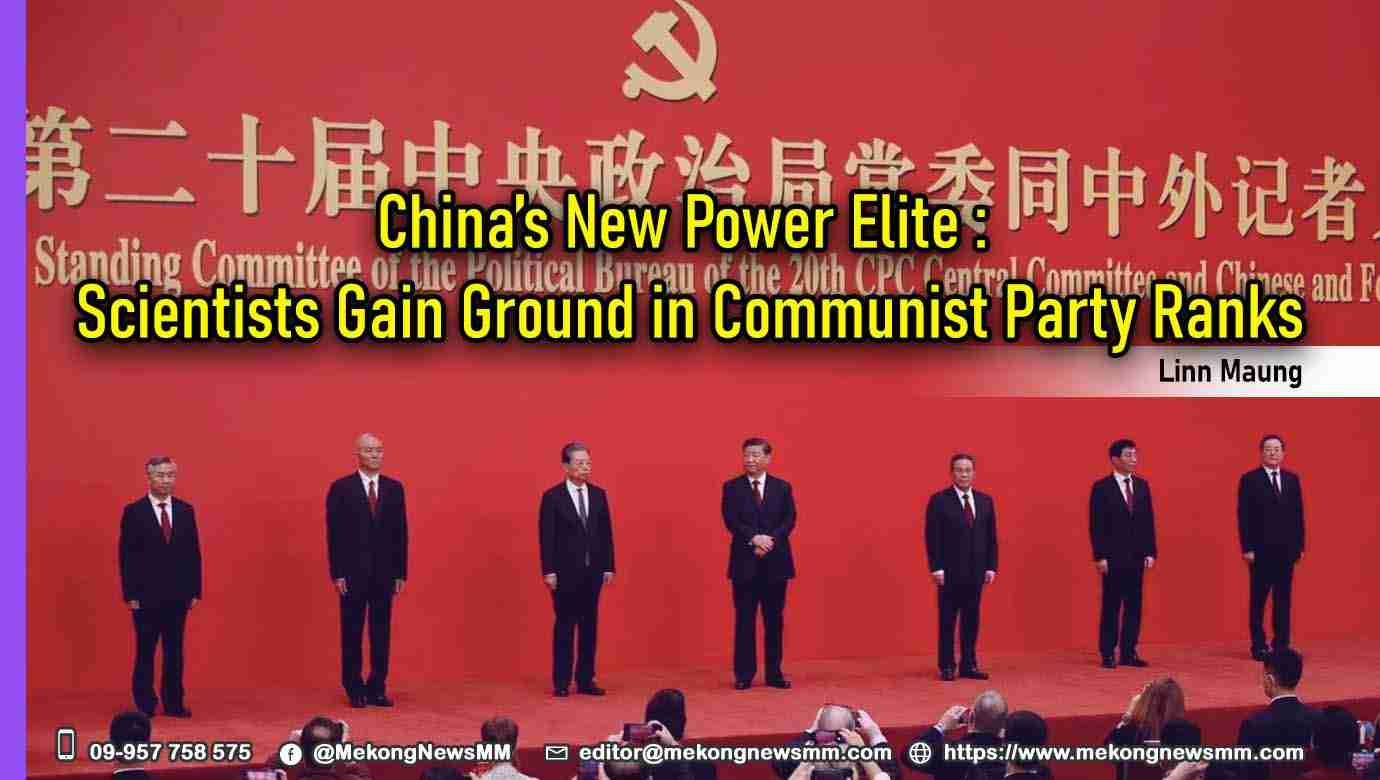
The steady rise of scientists within the upper echelons of the Communist Party of China is more than a routine reshuffle, it signals a structural shift in how Beijing conceives of power, governance, and national strength.
A decade ago, technocrats with deep scientific credentials were peripheral to political authority. In the 18th Central Committee, academicians from elite institutions accounted for just 15 members, roughly 3.5 per cent of the total. By the time the 20th Central Committee took shape, that figure had doubled to 30, or about 8 per cent. In a body of over 350 full and alternate members, that increase is not cosmetic, it reflects a recalibration of what constitutes political capital in Xi’s China.
Historically, the party’s upper echelons were dominated by provincial administrators, party cadres and military leaders. Scientists, even the most eminent, were kept at arm’s length, valued as advisers rather than decision-makers. That boundary is now blurring. Institutions such as the Chinese Academy of Sciences and the Chinese Academy of Engineering, which confer the prestigious “academician” title, have become pipelines into governance rather than just reservoirs of expertise.
What explains this shift is the leadership’s evolving definition of national power. Under Xi Jinping, the emphasis has moved decisively toward what Beijing calls “new-quality productivity”, a framework that prioritises breakthroughs in artificial intelligence, semiconductors, aerospace and advanced manufacturing. In such a system, scientific literacy is no longer optional for policymakers; it is foundational.
The emergence of a “revolving door with Chinese characteristics” captures this transition. Figures like Huai Jinpeng embody the trend: a computer scientist by training, an academician, then a vice-minister, and eventually a Central Committee member shaping education and industrial policy. This blending of laboratory expertise with administrative authority is now increasingly common.
Even at the level below the Politburo, the pattern holds. Leaders such as Chen Jining, an environmental scientist; Li Ganjie, with a background in nuclear safety; and Yuan Jiajun, a key figure in China’s space programme, illustrate how technical credentials are being translated into political authority. While none of them is an academician within the Politburo itself, their trajectories underscore the system’s preference for leaders who can navigate both governance and complex technological ecosystems.
This trend also reflects Beijing’s response to external pressures. As competition with the United States intensifies in areas like chips, AI and defence technology, China is seeking tighter integration between innovation and state power. Embedding scientists within the hierarchy ensures that policy formulation aligns with technological priorities and that bottlenecks in research, industrial policy, or education can be addressed from within the system.
Yet, this elevation comes with risks. The inclusion of scientists in the party apparatus exposes them to the same political scrutiny and controls that govern traditional cadres. The removal of several academicians amid anti-corruption probes since 2012 suggests that technical expertise offers no immunity. In fact, as scientists gain influence over funding, procurement and industrial policy, they also become more vulnerable to political campaigns.
In effect, China is not merely promoting scientists, it is redefining governance as a technopolitical enterprise. The Communist state is being recalibrated to fuse knowledge production with decision-making authority. Whether this produces more effective policy or constrains intellectual independence will depend on how far political discipline shapes, or distorts, scientific judgement.
#MeKongNews