

~ Linn Maung ~
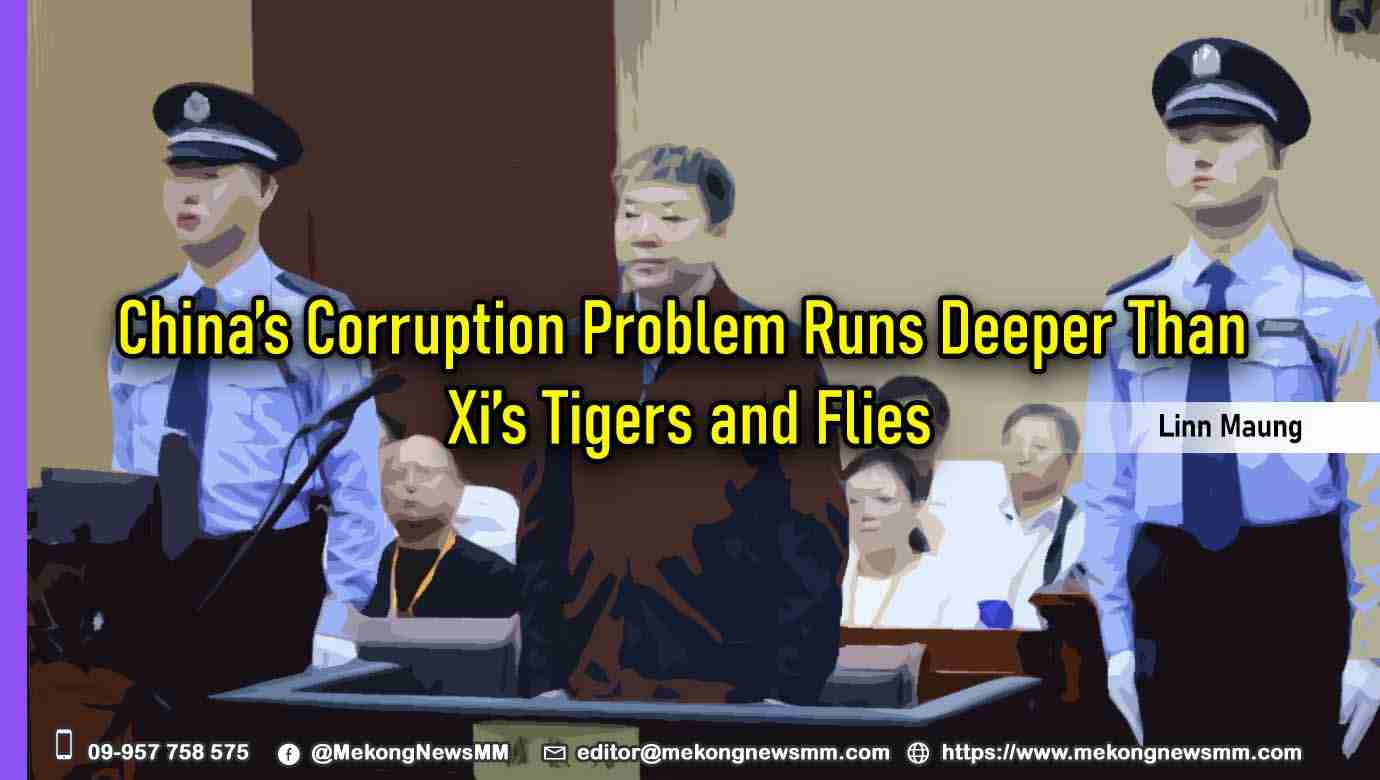
The sentencing of Zhou Xianwang, Wuhan’s former mayor, offers a reminder that China’s anti-corruption campaign has yet to eliminate the practices it was designed to eradicate. On October 10, 2026, a court in Henan sentenced Zhou to 14 years in prison for accepting more than 60.5 million yuan (US$9 million) in bribes over a period stretching from 2003 to 2025. According to the ruling, he used successive official positions to provide favours in business operations and administrative approvals. The case is striking not only for the amount involved, but also for how long the misconduct allegedly continued.
Since taking power in 2012, Xi Jinping has made the fight against corruption central to his leadership, promising to target both powerful “tigers” and low-ranking “flies”. The campaign has brought down senior officials, tightened party discipline and made corruption investigations a regular feature of Chinese politics. Yet Zhou’s case, alongside a steady stream of local scandals, points to a persistent problem of removing corrupt officials does not necessarily dismantle the networks and administrative practices that allow corruption to flourish.
The difficulty is especially visible at the grassroots, where officials control access to public funds, land, welfare benefits and everyday government services. Corruption here may involve smaller sums than a senior official’s illicit fortune, but it affects people more directly. It also exposes a limitation of a campaign measured heavily through investigations and punishments; enforcement can identify wrongdoing without necessarily changing the incentives that produce it.
The numbers behind the campaign
China’s official figures indicate that the problem remains extensive. In 2025, disciplinary authorities opened 1.012 million cases and punished 983,000 people. These included 137,000 officials at the township level and 91,000 current or former village party secretaries and village committee directors placed under investigation. In the first half of 2026, authorities opened another 538,000 cases, including investigations into 75,000 township-level officials and 54,000 current or former village leaders.
These figures cover a broad range of disciplinary cases, not only criminal bribery, and do not establish how prevalent corruption is across the entire bureaucracy. Nevertheless, the volume of investigations, particularly among township and village officials, shows that the problem extends well beyond a handful of powerful individuals.
The government has also expanded its focus on what it calls corruption affecting people’s immediate livelihoods. In 2025, authorities reported investigating 967,000 cases involving misconduct and corruption affecting ordinary citizens, punishing 627,000 people and referring 22,000 cases to prosecutors. The areas targeted included school meals, rural development funds and the administration of public benefits.
The scale of enforcement is considerable. But the recurring appearance of similar cases raises a more difficult question; why do local officials continue to risk punishment for practices that the party has spent more than a decade trying to stamp out?
Corruption in the everyday business of government
In rural China, village officials often exercise influence over collective land, community assets and funds intended for local development. In 2026, China’s disciplinary authorities highlighted cases in which village and community officials exploited weaknesses in the management of collective assets and finances. Such arrangements can involve private accounts, poorly documented transactions and the diversion of funds that residents have limited means of independently auditing.
Other cases involve the misuse of small amounts of public money alongside more direct exchanges of favours. In one case published by the disciplinary authorities, a community official in an unnamed Chinese city arranged for more than 700,000 yuan in funds intended to compensate residents assisting with public security work to be improperly reclaimed. The official also used fictitious part-time workers to obtain another 84,000 yuan and shared in payments from a businessman whose company received project contracts. The investigation covered conduct spanning several years. Such cases illustrate how corruption can become woven into the routine administration of public services. A community official does not need access to a major infrastructure contract to misuse public authority. Control over a small budget, a housing approval or a local procurement decision may be enough.
Funds intended for community services are diverted, access to approvals becomes less predictable, and relationships with local officials can determine who receives favourable treatment. The distinction between public administration and private benefit begins to blur.
Corruption is not limited to officials pocketing money. It can also take the form of manipulating the figures used to demonstrate administrative performance. Consider Nanning, the capital of Guangxi. China’s top disciplinary watchdog reported that local authorities had artificially inflated fiscal revenue by 2.83 billion yuan in 2024 through fabricated land-sale transactions. Fifteen parcels originally transferred to state-owned enterprises without payment were recorded as having been sold. One parcel was treated as sold 18 times, even though ownership had not genuinely changed. The arrangements helped present a stronger fiscal position during a prolonged property-market downturn.
The case points to a problem extending beyond conventional bribery. Local governments face pressure to meet revenue targets and demonstrate economic performance, even as falling land sales and property investment constrain their finances. Under these conditions, officials can have incentives to manipulate accounts rather than acknowledge deteriorating conditions.
Similar concerns have emerged around local-government debt. In September 2026, China’s anti-graft watchdog and finance ministry publicly identified officials in six cases involving new hidden debt or exaggerated claims about progress in reducing existing liabilities. One official in Sichuan was reported to have created 3.8 billion yuan in new hidden debt.
These cases matter because they reveal the limits of a system that relies on local officials to deliver growth targets while also policing their conduct. If career advancement depends on demonstrating success, the temptation to conceal failure does not disappear simply because the penalties for corruption become harsher.
Why the tigers-and-flies campaign keeps returning
Xi’s campaign has unquestionably imposed costs on corrupt officials. Zhou’s 14-year sentence is one example; the repeated investigation of village cadres and local administrators is another. The leadership has also shown that seniority does not guarantee protection from disciplinary action.
But punishment alone cannot resolve every problem identified by these cases. Some forms of corruption arise from personal enrichment, while others are sustained by opaque procedures, weak local oversight, political pressure to meet targets and the concentration of discretionary power in officials who control access to resources.
There is also a measurement problem. A rising number of investigations may reflect persistent corruption, stronger enforcement, or both. Official figures alone cannot tell us whether corruption is becoming less common across the country. Nor do they establish whether officials are changing their behaviour or simply finding different ways to evade scrutiny.
The more revealing test is whether the systems that make corruption possible are becoming harder to exploit. That requires transparent procurement, independently verifiable public accounts, clearer procedures for allocating rural funds and stronger oversight of local decision-making.
China’s anti-corruption campaign has demonstrated its capacity to investigate and punish officials at almost every level. Yet Zhou Xianwang’s case and the scandals involving village funds, fabricated land sales and hidden debt show that the problem is not confined to a few powerful individuals. The battle against the “tigers” and “flies” continues, but its persistence is itself revealing. A campaign can punish corruption repeatedly and still struggle to eliminate the conditions that make it worthwhile. Until those conditions change, new investigations will continue to expose not just individual wrongdoing, but the weaknesses of the system in which it occurs.
#MeKongNews