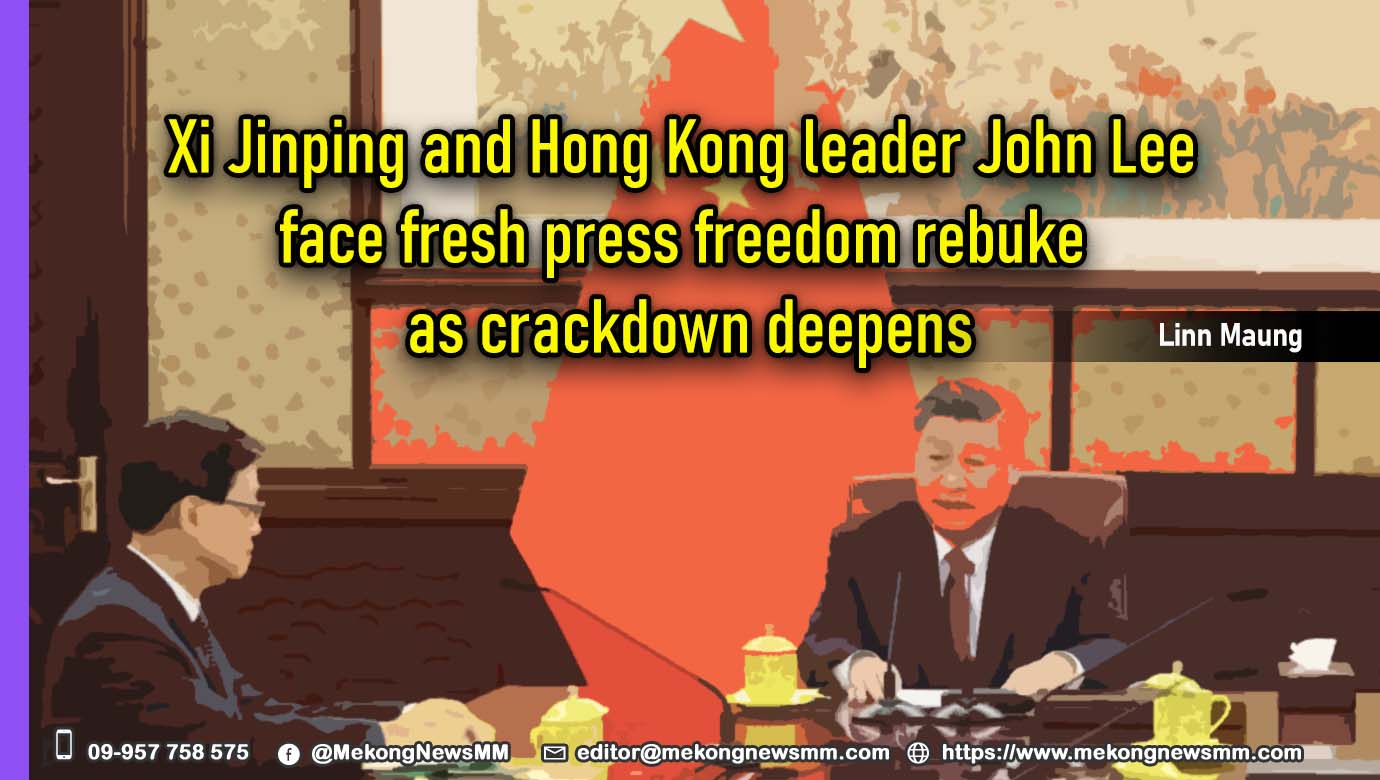
~ Linn Maung ~
A journalist behind bars, a newspaper forced to close, an editor facing a lengthy prison sentence and a newsroom learning to navigate an expanding list of forbidden subjects.
These are no longer isolated episodes in China’s media landscape. They have become part of a wider pattern in which national security, political loyalty and legal pressure increasingly define the boundaries of journalism.
The latest assessment by Reporters Without Borders (RSF) has again placed the Chinese Communist Party (CCP) and Hong Kong Chief Executive John Lee Ka-chiu on its 2026 Press Freedom Predators List.
Released on November 2, the report identifies the party under the security category for attacking, imprisoning and killing journalists, while Lee appears in the legal category for the use of judicial proceedings against media professionals.
Although the list names the CCP rather than Xi Jinping individually, RSF’s profile directly identifies the Chinese leader as the central figure behind the party’s policy of controlling information.
The organisation says China remains the world’s largest prison for journalists, with 111 news professionals detained.
The latest listing comes as Hong Kong’s media environment continues to deteriorate under an expanding national security framework, while mainland China maintains an extensive system of censorship, surveillance and restrictions on independent reporting.
Xi’s information-control system under scrutiny
Xi Jinping has repeatedly featured in RSF’s assessments since taking power in 2013.
The 2026 profile of the Chinese Communist Party describes an increasingly comprehensive system of information control, extending from traditional newsrooms to social media platforms, private conversations and encrypted communications.
RSF says China’s Great Firewall now filters not only foreign websites but also VPN services and encrypted messaging applications. Online content deemed politically sensitive or subversive faces censorship, while journalists and media organisations operate under scrutiny.
The organisation also points to the detention of 111 news professionals, describing China as the world’s largest prison for journalists.
Among the cases it highlights is veteran journalist Dong Yuyu, who remains in detention despite reportedly suffering from a lung tumour and deteriorating health.
RSF has raised concerns about his access to appropriate medical care.
Another case involves Zhang Zhan, the citizen journalist who reported from Wuhan during the early stages of the Covid-19 outbreak. After serving a prison sentence, she was detained again and sentenced in 2024.
RSF says she has also been denied the right to representation by a lawyer of her choice.
The organisation has further raised concerns about pressure on Thailand to initiate extradition proceedings against journalist Bai Zhaodong, who has reported on corruption in China.
RSF warns that returning him to China could expose him to persecution.
These cases illustrate the risks faced by journalists whose reporting challenges official accounts or examines politically sensitive subjects.
The pressure does not end with arrest or imprisonment. Restrictions on legal representation, access to medical care and contact with the outside world can deepen the consequences of detention.
Hong Kong’s media freedom falls sharply
The situation in Hong Kong reflects a related but distinct deterioration.
RSF has named John Lee for the second consecutive year, placing him among figures and institutions accused of using legal mechanisms to harass or suppress journalists.
Since becoming chief executive in 2022, Lee has overseen the implementation of Beijing’s national security framework and the introduction of the Safeguarding National Security Ordinance, commonly known as Article 23 legislation, in March 2024.
The 2020 National Security Law and the subsequent Article 23 legislation have expanded the authorities’ powers to investigate and prosecute activities considered threats to national security.
The Hong Kong government maintains that these measures are necessary to protect national security and restore stability.
Critics, however, argue that the broad scope of the laws has created uncertainty for journalists, publishers and sources, encouraging self-censorship.
Hong Kong’s position in RSF’s World Press Freedom Index reflects the scale of the decline. The city stood 18th in 2002 but fell to 80th in 2021 and 140th in 2026, out of 180 countries and territories.
It has remained in the index’s lowest category, described as “very serious”, for two consecutive years.
The 2026 ranking places Hong Kong at 140th, while mainland China stands at 178th. The figures underline the deterioration of press freedom across both jurisdictions, although their political and legal systems remain distinct.
Jimmy Lai’s 20-year sentence becomes a defining case
The imprisonment of Apple Daily founder Jimmy Lai remains one of the most prominent examples of Hong Kong’s changing media environment.
On February 9, 2026, Lai, 78, was sentenced to 20 years in prison after his conviction on charges of conspiracy to collude with foreign forces under the National Security Law and conspiracy to publish seditious publications.
Eight other defendants, including six former Apple Daily staff members, received prison terms ranging from six years and three months to 10 years.
The sentence followed a lengthy legal process that began with Lai’s arrest in 2020.
Prosecutors cited Apple Daily articles and the newspaper’s editorial activities as part of their case, arguing that Lai had conspired to seek foreign intervention against China and Hong Kong.
Hong Kong authorities defended the verdict as a lawful response to serious national security offences. Chief Executive Lee described Lai’s conduct as harmful to the city and said the sentence demonstrated the operation of the rule of law.
Human Rights Watch, RSF and other international rights organisations condemned the sentence, arguing that it represented a severe blow to media freedom.
RSF described the 20-year term as an exceptionally harsh punishment for a publisher and called for his release.
Apple Daily had already been forced to close in June 2021 after authorities froze its assets and arrested senior executives. Its closure removed one of Hong Kong’s most prominent independent newspapers from the media landscape.
The subsequent shutdown of online outlet Stand News in December 2021, followed by the conviction of two former editors for sedition in 2024, further narrowed the space for independent journalism.
New arrests and legal pressure deepen concerns
The pressure on Hong Kong’s media sector has continued beyond the cases involving Apple Daily and Stand News.
RSF’s 2026 profile of John Lee refers to the 48-hour detention of Tang Ho-wing, founder of independent news outlet Boom News, and an investigation into allegations of incitement through the spread of disinformation.
The organisation also highlights harassment, death threats and smear campaigns directed at members of press freedom groups, including the Hong Kong Journalists Association.
The Hong Kong government’s national security framework has also continued to expand. In March 2026, the authorities amended the implementation rules of the National Security Law, extending investigative powers and provisions concerning asset forfeiture.
On March 24, national security police arrested independent bookseller Pong Yat-ming and three others under the Safeguarding National Security Ordinance over the alleged sale of seditious publications.
The developments have reinforced concerns among press freedom organisations that the boundaries of national security offences can extend into publishing, commentary and the circulation of material.
The British government’s latest six-monthly report on Hong Kong, published on October 22, 2026, also recorded the continuing impact of national security legislation on freedom of expression, assembly, association and the press.
It noted the 20-year sentence imposed on Lai and the continued use of the National Security Law and Article 23 legislation.
Widening gap between official assurances and media realities
Hong Kong officials have repeatedly rejected allegations that the authorities are suppressing press freedom. They maintain that journalists remain free to report within the law and that national security legislation targets criminal conduct rather than legitimate journalism.
Lee has also called on media organisations to maintain professional standards and contribute to what he has described as the development of Chinese discourse and narratives in support of national interests.
Yet the repeated arrests, prosecutions, closures and restrictions have created a media environment in which journalists must weigh the potential legal consequences of their work.
The uncertainty surrounding what may constitute sedition, collusion or the dissemination of disinformation has become a central concern for independent media groups.
In mainland China, the scale of detention and censorship remains considerably more extensive.
RSF’s assessment describes a system in which the ruling party seeks to control not only what is published but also how information circulates through digital platforms and private communication channels.
RSF seeks to expose those behind the restrictions
RSF released its 2026 Press Freedom Predators List on November 2 to mark the International Day to End Impunity for Crimes Against Journalists. The list identifies 33 individuals and organisations across five categories: political, security, legal, economic and social.
Director-General Thibaut Bruttin said the initiative was intended to expose the methods used by those responsible for attacks on journalists and media outlets.
The list complements the organisation’s annual World Press Freedom Index, which measures conditions across countries and territories, by identifying the actors RSF considers responsible for specific forms of repression.
The organisation also noted that several figures included in its 2025 list had since experienced major political reversals.
Iran’s Supreme Leader Ali Khamenei was killed in a US strike, while Venezuela’s Nicolás Maduro was arrested in a US operation and is being held in federal custody. Political changes in Hungary and Serbia have also altered the positions of leaders previously named.
For China and Hong Kong, however, the latest listing reflects the persistence of the restrictions rather than a change in direction.
Xi’s leadership continues to be associated by RSF with an extensive system of information control, while Lee remains under scrutiny for the legal framework governing Hong Kong’s media.
The cases of detained journalists, closed newsrooms and lengthy prison sentences have given the organisation’s assessment a concrete basis.
Behind the rankings are reporters unable to work freely, publishers serving prison terms and media organisations operating under the threat of prosecution. The repeated inclusion of the CCP and Hong Kong’s chief executive places that record back under international scrutiny.
#MeKongNews